

Over the last month, I’ve spent a lot of time looking backward. Not because I think AI is simply repeating an earlier technology cycle. It isn’t. But after more than two decades working through successive changes in digital marketing, I’ve learned that new technologies often create familiar institutional problems before the market has language for them.
I started this series believing those were four useful historical analogies. I’m ending it believing they are pieces of the same story. AI is forcing digital commerce to confront all four problems at once. And what comes next is bigger than another measurement category.
It is the economic infrastructure for machine-mediated commerce.
The First Mistake Is Confusing What We Can See With What Matters
Every new technology creates new observables. Social gave us followers, Likes and engagement. Search gave us rankings and position. Mobile gave us installs. Digital advertising gave us impressions and clicks.
AI gives us citations, mentions, recommendations, prompt coverage, visibility scores, and Share of Shortlist™. Those signals matter. We should measure them. We should learn from them. Brands that begin building structured practices around AI discovery now will learn faster than those that wait. Search taught us that lesson too. Early measurement creates knowledge, and knowledge compounds.
But history also gives us a warning. What is observable first rarely becomes the final economic unit of the market. The Facebook Like was useful. It just wasn’t value. A search ranking was useful. It just wasn’t revenue. An app install was useful. It just wasn’t lifetime value. An impression could be real without being viewable. A click could occur without being valid or billable. And an AI citation can exist without creating meaningful commercial influence.
The recurring mistake is not measuring these things. The mistake is stopping there.
AI Changes Something More Fundamental Than the Interface
The most important change in AI discovery is not that the search box has become conversational. It is that machines are increasingly participating in consideration itself. Traditional search largely gave consumers a ranked set of possibilities. AI can synthesize publishers, creators, reviews, retailers, product information, and other sources and return a much smaller set of recommendations. The machine is helping construct the shortlist.
That is why I believe Share of Shortlist™ matters. Visibility tells us that a machine knows a brand exists. Share of Shortlist tells us whether that brand is actually entering the consideration set. That is a considerably more consequential signal.
But this series has really been about what comes after that. Because being considered and creating economic value are still different things. A consumer can ask an AI assistant which running shoes are best for a first marathon. The system can synthesize information from publishers, product reviews, creators, retailers, and manufacturers. It can narrow dozens of possibilities to three. One brand makes the shortlist. Another doesn’t. Something economically meaningful may already have happened.
But then the consumer might buy through a retailer app. Or search directly tomorrow. Or walk into a store. Or buy through a marketplace. Or ask another AI system another question. The influence can happen without the click. And when the click disappears, something else disappears with it: the observable bridge between discovery and outcome.
Search had that bridge. AI increasingly does not. That is the measurement problem hiding underneath the AI visibility boom.
The Click Was Infrastructure
For years, we treated the click as if it were the value. It wasn’t. The click was infrastructure. It connected two environments that otherwise had relatively little knowledge of one another.
On one side: Discovery. On the other: Behavior, conversion, revenue, and customer value.
The click helped join them.That connection allowed marketers to build a feedback loop: Measure → Learn → Optimize → Reallocate
And that is ultimately what made search economically important. Not rankings. Not clicks. The ability to learn where economic value was being created and move capital accordingly.
AI doesn’t reliably give us the same connective tissue. That means the answer cannot simply be better click attribution. We have to build a system capable of learning when the click is absent.
Mobile Shows Us What Markets Do When the Old Infrastructure Stops Working
Mobile is perhaps the clearest precedent. When consumer behavior moved from the web into apps, cookies, referrers, pixels, and URLs did not travel cleanly with it. The market did not conclude that mobile was unmeasurable. It built new infrastructure.
Mobile measurement partners connected acquisition claims to installs, post-install behavior, revenue, and lifetime value. More importantly, they created an independent layer between platforms selling media and advertisers trying to understand which claims to trust.
That independence became essential because the platforms had economic interests in the answers. Measurement wasn’t simply describing the market. It was determining where money moved next.
And then mobile measurement faced another disruption. Privacy weakened some of the deterministic signals the original system had relied upon. Again, the industry did not abandon measurement. It became more explicit about what could be observed deterministically, what could be measured in aggregate, what required modeling, and what the available evidence actually justified concluding.
That is a particularly important lesson for AI.
The standard cannot be: Can we deterministically connect every individual source to every individual transaction? Where deterministic evidence exists, use it. But the more useful question is: What evidence exists, and what conclusions does that evidence justify?
Sometimes the answer will be deterministic. Sometimes statistical. Sometimes aggregate. And sometimes the evidence will not support the claim at all.
That last possibility matters enormously.
Verification Only Matters If the Answer Can Be No
This may be the most important idea I take away from the entire series.
Attribution tends to begin with: Who gets credit?
Verification asks a prior question: Is there sufficient evidence that meaningful influence occurred?
That sequencing matters.
Because a system that always finds influence is not verifying anything. It is manufacturing credit. Digital advertising learned this before us. An impression could occur without meeting the standard for viewability. A click could occur without meeting the standard required to make it billable. The event existed. But existence alone did not make it economically eligible.
AI requires the same discipline. Observed influence should not automatically become economic credit. It should have to clear a verification threshold.
And credible verification has to work in both directions: Discard influence that does not clear the evidentiary standard. And: Recognize influence that does, even when no click made it visible.
The objective is not more credit. It is more accurate economic recognition.
Some are already proposing that the citation will replace the click as the currency of the next digital economy. But replacing the click with the citation doesn’t solve the measurement problem. It simply changes what we’re counting. A citation is not a conversion. It is not necessarily evidence of incremental value. And it is not the only way a publisher can influence a commercial outcome.
We spent two decades learning that counting something does not make it economically meaningful. We should not need another two decades to learn that lesson again. The next standard cannot simply determine who appeared in an answer. It must establish whose contribution deserves economic recognition, how that contribution is verified, and how capital should move as a result.
There Is a Layer Between Measurement and Money
One concept became much clearer to me as I wrote these pieces: Economic eligibility.
We talk about measurement. We talk about attribution. We talk about visibility. We talk about compensation.
But something has to happen between observing a signal and allowing money to move because of it. An impression can exist without being economically eligible. A click can exist without being economically eligible. And AI influence can be observed without automatically being economically eligible.
That suggests a more complete architecture: Visibility → Influence → Verification → Economic Eligibility → Governance → Economic Action
Each stage answers a different question.
Visibility: Are we present?
Influence: Are we shaping consideration?
Verification: Does the evidence clear the required threshold?
Economic eligibility: Does the verified contribution meet the agreed conditions for economic treatment?
Governance: What treatment should apply?
Economic action: Where should value and money move?
And economic action can take two important forms. It should mean compensating publishers and creators for verified influence under agreed commercial rules. It should also mean reallocating acquisition capital toward the sources creating measurable commercial value.
Often, it should mean both. 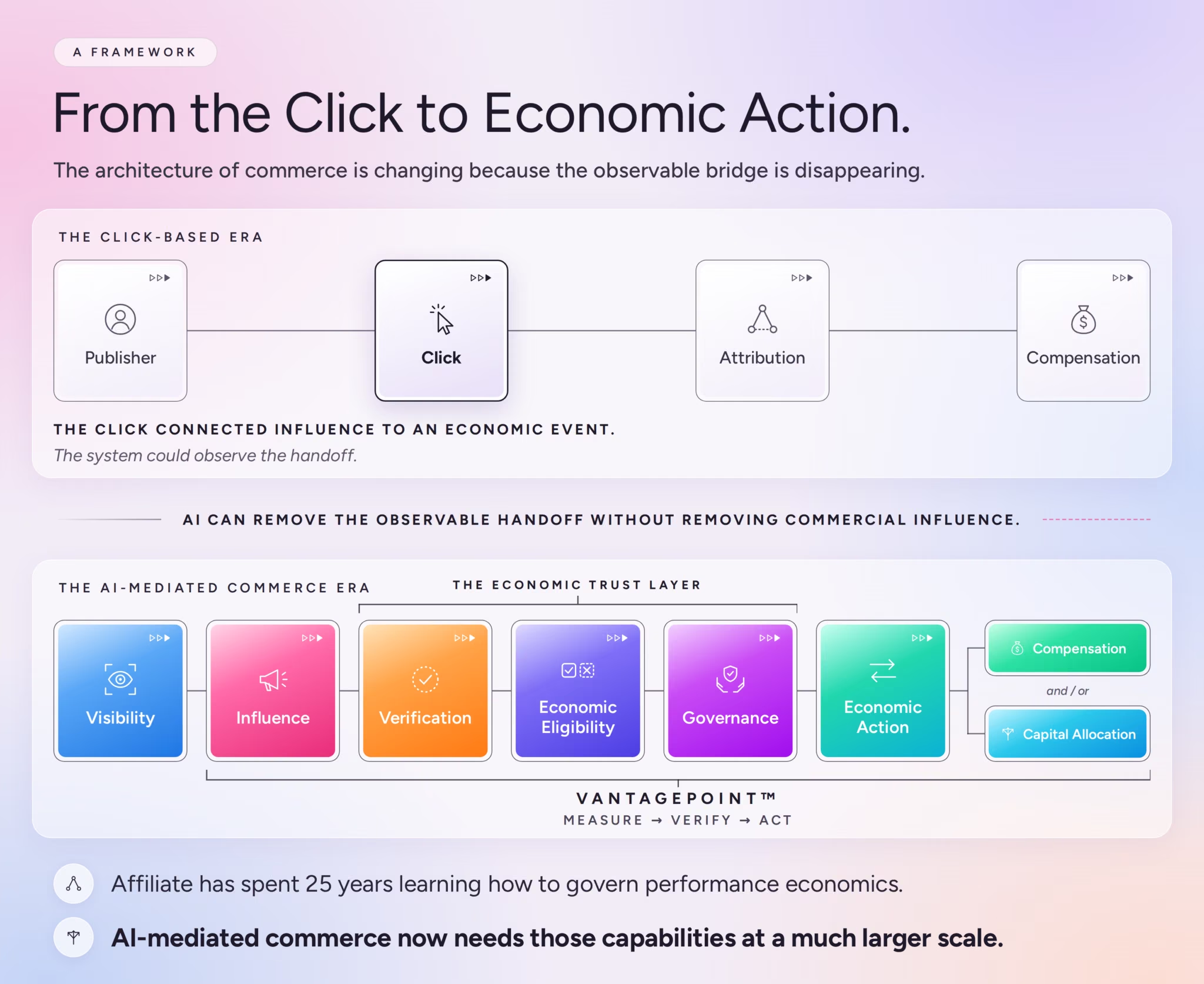
This Is Bigger Than Attribution
This is where I think our industry needs to raise its sights. Affiliate marketing has spent much of its history debating attribution. Which partner gets credit? Which click wins? What lookback window applies? Which commissioning rule should govern the transaction?
Those questions mattered because the click was the observable infrastructure available to us. But AI creates a larger opportunity. Publishers and creators can now contribute to a commercial outcome without receiving the traffic that historically made their influence visible.
That creates a real economic problem. Where a publisher’s contribution to commercial outcomes can be credibly verified and meets agreed commercial conditions, it should be eligible for compensation. At the same time, advertisers should be able to identify which publishers, sources and discovery environments produce verified commercial value and reallocate capital accordingly. Evidence sufficient to inform an investment decision may not be sufficient to settle a publisher payment. The standard has to reflect the decision being made.
That is not merely a better attribution model. It is a different economic system. And affiliate has something unusually valuable to contribute to it. We already operate where publishers, brands, outcomes and compensation meet. We understand commissioning. We understand governance. We understand what happens when commercial rules have to be applied across thousands of economic relationships.
The opportunity is not to make AI fit inside yesterday’s affiliate model. It is to take what affiliate learned about governing performance and apply it to a much larger machine-mediated economy.
That Requires Us to Let Go of the Click
This is also where our category has a choice to make. The click built affiliate marketing. It gave the category a simple, auditable commercial event. It enabled performance-based compensation at enormous scale. We should respect what it created. But we should not confuse the infrastructure that built the category with the boundaries of the category itself.
If meaningful commercial influence increasingly happens before, around, or entirely without the click, then defending click-based measurement as the definition of performance does not protect affiliate marketing. It constrains it.
Creators are not the answer by themselves. Workflow automation is not the answer by itself. Putting AI features inside an affiliate platform is not the same thing as defining affiliate’s role in an AI economy.
The larger question is: Can this industry help create the rules by which influence becomes economically actionable when the click no longer tells the whole story?
I believe it can. But only if we are willing to move beyond the system that got us here.
We Also Cannot Let the New Walled Gardens Grade Their Own Homework
There is another path we should avoid. Large language models are increasingly becoming walled gardens of discovery. They decide which information gets retrieved. Which sources appear. Which brands make the shortlist. Which products are recommended. And increasingly, they may influence the consumer’s path toward a commercial decision.
Those platforms will generate increasingly sophisticated analytics. We should use them. Consumer trust is not the same as economic trust. A consumer may trust an AI assistant’s recommendation enough to act on it. But that does not establish which publisher, creator, or source contributed to the decision, whether that contribution can be credibly verified, or whether it deserves economic recognition. Trusting the recommendation is not the same as trusting the evidence used to move money.
But platform-native data cannot become the only authority on the economic value created inside those environments. We have seen that movie before too. The environment shaping the consumer’s experience should not also become the sole judge of what that influence was worth. We don’t need another GA4 for the AI era. We need an independent layer capable of evaluating evidence across environments, connecting credible influence to downstream outcomes and applying a consistent standard regardless of who benefits from the answer.
This is already beginning in paid AI media. On October 5, DoubleVerify announced attribution measurement for ChatGPT ads, while both DoubleVerify and Integral Ad Science announced work on brand suitability measurement in that environment. That is an important sign that independent measurement is becoming part of AI’s commercial infrastructure. It does not, by itself, establish how publisher contributions to organic AI recommendations should be verified, governed, or compensated. That remains a separate measurement and economic question.
And the Same Standard Has to Apply to Partnerize
This is where humility matters. It would be easy for us to say: Partnerize should be that independent layer. That is not enough. Partnerize participates commercially in this ecosystem. We work with advertisers. We work with publishers. Our technology facilitates transactions between them. We have economic interests around the system we are building.
So the standard for VantagePoint™ cannot be: Trust us. It has to be: Can our interests change the answer? Can they change the methodology? Lower the evidentiary threshold? Determine which claims become Verified? Cause the same evidence to produce a different conclusion depending on who benefits? They cannot be allowed to.
The same evidence has to produce the same conclusion regardless of whether that conclusion benefits a publisher, an advertiser, or Partnerize. That is why Discarded has to be as legitimate an outcome as Verified. It is why methodology matters. Why controls matter. Why auditability matters. Why standards matter. And why external scrutiny matters.
VantagePoint has achieved AAM Platform Certification. We have also formally embarked on the MRC accreditation process and have officially been classified as a Service Under Review for the pre-audit. That status is a step in the process, not MRC accreditation.
Those aren’t decorations around the product. They are part of what it means to build infrastructure that businesses might eventually trust enough to move money against.
In our Lighthouse early access program, VantagePoint is already being used to compensate publishers for verified influence in clickless journeys. That is an initial commercial application, not proof that every measurement question has been resolved. The burden now is to demonstrate that the process is repeatable, auditable, and useful for both publisher compensation and advertiser investment decisions.
Our objective cannot be to ask the market to trust Partnerize. It has to be to build a system the market can verify.
Standards Are How Measurement Becomes a Market
The history of digital advertising provides one final lesson. Measurement alone was not enough. The market had to agree on definitions. Then standards. Then verification against those standards. Then commercial rules governing what happened economically.
That is how concepts like valid clicks, viewability, invalid traffic, and makegoods became part of a functioning market. The fourth installment traced how standards and transaction rules eventually made measurement part of digital advertising’s economic infrastructure.
AI influence will need its own institutional architecture. Not because every participant needs to use the same proprietary methodology. They shouldn’t. Innovation should remain competitive. But markets need common enough definitions to transact. What counts as influence? What evidence is sufficient? What makes influence economically eligible? How should competing claims be governed? When should compensation occur? When should verified influence change where an advertiser invests? What happens when the evidence does not clear the standard?
Those questions are not simply product questions. They are market-design questions.
And this is where industry bodies, independent auditors, advertisers, publishers, agencies, technology providers, and AI platforms all have roles to play. No one company should define the answer alone.
Including ours.
The Destination Is Not Measurement
After four installments about measurement history, that may sound like a strange conclusion. But measurement isn’t the destination. Better economic decisions are.
Search matured when visibility could inform where the next dollar went. Mobile matured when marketers could compare the economic quality of customers across acquisition sources. Digital advertising matured when verified delivery could affect payment, reconciliation, and future investment.
AI will mature when businesses can move from:
Where did we appear?
to:
Did we influence consideration?
to:
Can that influence be verified?
to:
Is it economically eligible?
to:
How should it be governed?
and ultimately:
What should we do differently because we know?
That last question is the one that matters. Because once the answer changes compensation or capital allocation, AI influence stops being a dashboard metric.
It becomes economic infrastructure.
What This Means for Affiliate
As the industry gathers at PI LIVE, a lot of people I respect will discuss where this category goes next. There will be legitimate debate. About AI. About creators. About automation. About trust. About platforms. About the future role of affiliate and partnership marketing.
I don’t think any one company has the complete answer. Partnerize certainly doesn’t. The market is moving too quickly, the measurement problems are too difficult, and the economic interests are too varied for anyone to credibly claim that.
But I do think history gives us a useful direction. Affiliate should not define its future by defending the click. And it should not define its relevance by how much AI functionality can be added to the workflows we already operate. Affiliate has spent 25 years learning how to govern performance economics. AI-mediated commerce now needs those capabilities at a much larger scale. The opportunity is not to extend affiliate’s boundaries. It is to extend the capabilities affiliate has built.
The opportunity is to help define how commercial influence is verified, governed, and economically recognized in a world where machines increasingly mediate discovery.
That is a much larger ambition. It is also a much larger market. Publishers need a way to demonstrate value when traffic disappears. Creators need economic systems that price contribution more credibly than reach and negotiation. Advertisers need to know which influence is trustworthy enough to inform investment. Agencies need common rules they can apply across clients and environments. AI platforms need a healthy ecosystem of authoritative sources capable of continuing to produce the information their systems depend upon. And all of them need confidence that the party measuring the system cannot simply grade its own homework.
That is not an affiliate problem. It is a commerce problem. Affiliate just happens to have spent the last twenty-five years building some of the institutional muscle required to help solve it.
The Movie Is Familiar. The Ending Isn’t Written.
When I started this series, I called it We’ve Seen This Movie Before. That was intentionally provocative. AI is not Facebook. It is not search. It is not mobile. And AI influence is not an impression, a click, or an install. History doesn’t repeat that neatly. What repeats are the questions markets eventually have to answer.
What can we observe?
What actually matters?
What can we verify?
What should count?
Who gets to decide?
What happens economically once we know?
Social, search, mobile, and digital advertising each answered pieces of those questions. AI is forcing us to answer all of them together. That is why I don’t think the next great infrastructure opportunity is another visibility dashboard.
It is the trust layer between influence and economic action. A layer capable of observing without confusing observation with value. Verifying without manufacturing certainty. Discarding claims that don’t clear the standard. Recognizing contribution the click can no longer see. Governing competing economic interests. Compensating those who verifiably create value. And helping businesses allocate capital toward the sources and environments that actually produce it.
The architecture, in its simplest form, is:
Visibility → Influence → Verification → Economic Eligibility → Governance → Economic Action
And economic action resolves into:
Compensation | Capital Allocation
I don’t know exactly what every component of that market will look like five years from now. Nobody does. But I am increasingly convinced of the direction.
Visibility isn’t value.
Influence isn’t automatically economic eligibility.
Verification has to come before governance.
Governance has to come before money moves.
And when money does move, it should move because the evidence was strong enough to justify it. That is the system we are trying to help build. Not because Partnerize should get to define the future of AI commerce. But because someone has to start building the infrastructure that allows the market to define it together.
That distinction matters.
The biggest opportunity in front of affiliate isn’t to protect the economics of the system we built around the click. It is to help build the economic system that comes after it. For publishers and creators, that means restoring economic recognition to influence that became invisible when the click disappeared, when that contribution can be credibly verified. For advertisers, it means moving capital toward the sources and discovery environments producing verified commercial value. For the industry, it means creating standards, governance, and independent validation strong enough that all sides can trust the system even when they disagree with an individual outcome.
And for companies like Partnerize, it means accepting a higher burden of proof if we want to participate in building that infrastructure.
The future of AI-mediated commerce will not be determined by who measures the most activity. It will be determined by what the market can trust enough to count, govern, and act on economically. Because once we can do that, a much bigger question becomes possible: What should happen economically because it counted?
That is where compensation becomes possible. That is where capital allocation becomes possible. That is where measurement becomes governance. And that is where a category built around the click has an opportunity to become something much larger than affiliate marketing as we have historically defined it.
We’ve seen pieces of this movie before.
But this time, we are building what comes next.
See how VantagePoint turns AI influence into economic intelligence.