










There was a period in digital marketing when everyone wanted Likes. Brands accumulated Facebook followers by the millions. Agencies built strategies around them. Software companies built dashboards to measure them. Executives watched the numbers climb.
And for a while, we treated that growth as evidence that something valuable was happening. Then someone eventually asked the uncomfortable question: What is a Like actually worth?
The answer turned out to be complicated.
Some Likes represented genuine affinity. Some led to engagement. Some influenced purchases. Others represented almost nothing at all. The Like wasn’t useless. We had simply confused an observable signal with economic value.
I think we are doing it again. This time, the metric is AI visibility.
The New Race for Visibility
As discovery moves into ChatGPT, Gemini, Claude, Perplexity, and other answer engines, an entirely rational industry has emerged around helping brands understand whether they appear in AI-generated responses.
Are we being mentioned?
How often?
For which prompts?
Which competitors appear alongside us?
Which sources are being cited?
These are important questions. Brands absolutely need to understand how they are represented inside an increasingly machine-mediated market. But they are beginning questions. Not ending ones.
A citation is not a commercial outcome any more than a Facebook Like was. A brand can appear in an AI response because it is recommended. It can appear because it is being compared unfavorably with something else. It can appear because the model is explaining why another product may be a better choice.
Three citations. Three very different forms of value. Counting them equally tells us remarkably little. Visibility is an input. Commercial value is the outcome.
From Share of Voice to Share of Shortlist™
There is an even more important difference between the social era and the AI era. AI compresses consideration. Traditional search gave consumers pages of possibilities. Social feeds gave brands countless opportunities to appear. Answer engines increasingly synthesize all of that information and return a much smaller set of recommendations. The machine is helping build the consideration set.
That changes what matters.
The question isn’t simply: “Did my brand appear?” It is: “Did my brand make the shortlist?”
That is why I believe Share of Shortlist™ will ultimately matter more than share of AI visibility. Visibility means the machine knows you exist. Share of Shortlist means the machine believes you belong in the consumer’s consideration set. That is a much more consequential position.
But even that is not enough. Because being considered and creating economic value are still different things.
The Click was Never the Value
For more than two decades, digital marketing benefited from an incredibly convenient observable event: the click.
Someone saw something. They clicked. They landed somewhere. They bought.
The click became the connective tissue between influence and commerce. But the click was never the value. It was simply a signal that happened to be relatively easy to observe. AI is exposing that distinction.
A consumer can ask an answer engine for the best running shoes for marathon training. The model can synthesize reviews, publisher content, product information, and other signals before recommending three brands. The consumer may never click any of the sources that shaped that recommendation. They may not even click the brand. They may buy later through an app, navigate directly to a retailer, or complete the purchase somewhere else entirely.
The commercial influence occurred. The traditional evidence trail did not.
That is why I don’t believe the answer to AI commerce is simply better click attribution.
We need to learn how to measure influence when the click disappears.
We’ve Reached the Dashboard Phase
Every major technology transition seems to produce a dashboard phase. Something new becomes measurable, so we measure it enthusiastically. Social gave us followers, Likes, impressions, and engagement dashboards. AI is giving us visibility scores, citation counts, prompt coverage, and competitive visibility indexes. These tools are useful. They tell marketers something they couldn’t previously see. But telemetry is not an economic system.
Eventually the CFO arrives. And the questions change.
What did this influence?
Did it change consumer behavior?
Did it contribute to revenue?
How confident are we?
Who created the value?
What was that contribution worth?
And where should we invest the next dollar?
Those questions require a very different infrastructure.
The Maturity Curve for AI Commerce
I think the market is moving through a predictable progression:
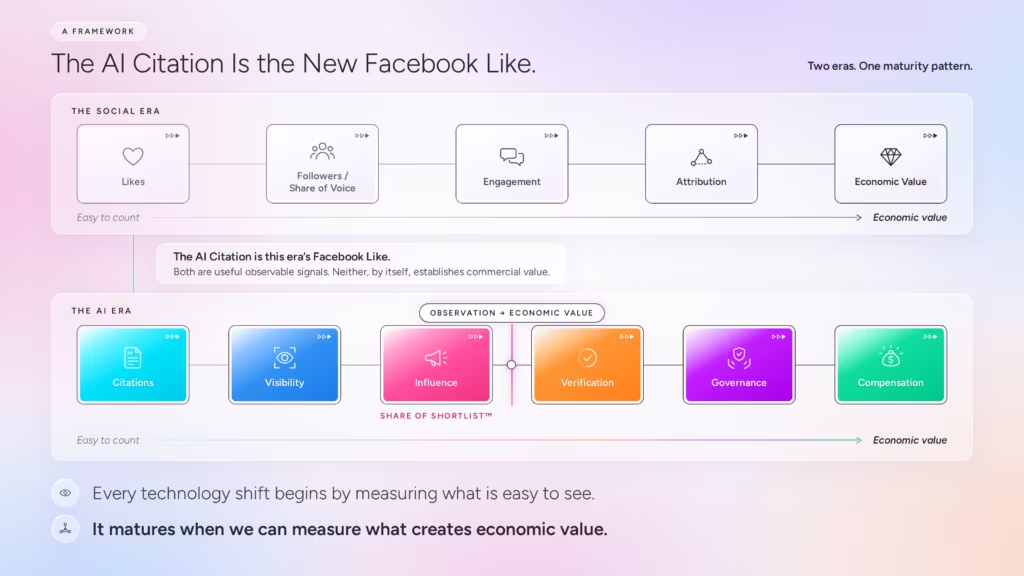
Visibility → Influence → Verification → Governance → Compensation
Visibility tells you whether you are present. Influence tells you whether that visibility is shaping consideration. Share of Shortlist is one way to understand whether a brand has moved from simply appearing to actually entering the consideration set. Verification is the critical gate. It establishes whether the influence meets an agreed evidentiary standard and can be connected with sufficient confidence to downstream commercial behavior. Governance determines how verified influence should be treated. Compensation allows money to move against the value that was created.
The farther right we move on that continuum, the closer we get to economic value. That is where this becomes much bigger than another marketing dashboard.
This Matters for Publishers and Creators, Too
There is another lesson from the social era worth remembering. When platforms changed the rules, entire ecosystems discovered that attention and economics were not the same thing. AI is creating a similar tension for the open web.
Publishers, creators, reviewers, and other authorities may substantially shape what an AI system ultimately recommends while receiving little or no traffic from the consumer whose decision they helped influence. Their content can create value without producing a click. That creates a fundamental economic problem.
If we cannot identify and verify that contribution, we cannot govern it. And if we cannot govern it, we cannot reliably compensate it.
This is why the future of AI commerce cannot stop at answering which brands are visible.
We also need to understand which sources influenced those recommendations, whether that influence contributed to commercial outcomes, and how value should move through the ecosystem as a result.
Every Vanity Metric Eventually Meets an Economic Question
The Facebook Like didn’t disappear because marketers stopped caring about audiences. The market simply matured. The questions became harder.
Engagement mattered more than audience size. Conversion mattered more than engagement. Incrementality mattered more than conversion. And eventually, marketers demanded some defensible connection between investment and economic return.
AI visibility will follow the same path.
Right now, much of the market is understandably focused on getting brands into the answer. Soon the question will be whether they made the shortlist. Then whether being on that shortlist changed behavior. Then whether that influence can be independently verified.
And eventually: What was it worth?
That is the transition I believe we are entering now. The first phase of AI commerce is about visibility. The next phase will be about value.
And history suggests the second question is where the real infrastructure gets built.
Don’t build your AI commerce strategy on yesterday’s vanity metrics. Measure influence. Verify contribution. Govern value. See VantagePoint™ in action.