

I have spent a lot of time recently arguing that AI visibility should not be confused with commercial value. That doesn’t mean brands should wait to invest in understanding it. Quite the opposite. I’ve seen an earlier version of this transition up close.
More than two decades ago, I was at Ask Jeeves as search was becoming a mainstream interface for navigating the internet and marketers were beginning to understand what that meant for their businesses.
At first, the questions were relatively straightforward:
Where do we rank?
For which searches?
Who appears ahead of us?
How do we move higher?
Those questions mattered. And companies that developed the ability to understand and improve their organic visibility built valuable expertise while the discipline was still taking shape. But that isn’t the most important lesson from the history of SEO. The bigger breakthrough came when we began connecting being found to what happened next. That distinction matters enormously as we enter the AI era.
Because once again, we are getting very good at measuring the thing that is easiest to see: Visibility.
And once again, the much bigger opportunity lies in understanding what happens next.
SEO Didn’t Become a Measurement Discipline Overnight
It’s easy to look backward and assume the economic importance of organic search was obvious from the beginning. It wasn’t. Early SEO measurement was dominated by what could readily be observed: rankings, keywords, and position on the search engine results page.
That information was valuable. But knowing that you moved from position five to position two didn’t answer the question a business ultimately cared about: What was that worth?
Over time, the measurement system became considerably more sophisticated. One important inflection point came around 2010, when enterprise SEO platforms began integrating organic search data with the web analytics systems companies were already using to measure consumer behavior and commercial performance. BrightEdge was an early leader in that transition. Its BrightEdge Connect product integrated search metrics such as rankings with analytics data from systems including Omniture, Coremetrics, Webtrends, and later Google Analytics.
That may sound unremarkable today. At the time, it represented an important change in what SEO could become. The question was no longer simply: Where do we rank? It was increasingly: What happened because we were there?
Rankings could be connected to traffic. Traffic could be connected to conversions. Conversions could be connected to revenue. And eventually another question became possible: Given what we’ve learned, where should we invest next? That progression changed the role of SEO.
Visibility → Traffic → Conversion → Revenue → Capital Allocation
SEO was becoming more than a practice for improving rankings. It was becoming a measurement and investment discipline.
The Click Connected the System
There was an important piece of infrastructure sitting in the middle of that evolution. The click.
A consumer searched. A result appeared. The consumer clicked. They arrived somewhere the marketer could observe them.
Analytics could then begin connecting that visit to downstream behavior and, ultimately, a commercial outcome. None of this made SEO attribution perfect. A click didn’t prove incrementality. Consumer journeys crossed devices and channels. Branded search complicated causality. Attribution models remained imperfect.
But the click gave marketers something incredibly useful: An observable behavioral bridge between discovery and what happened next.
That bridge helped connect two measurement environments that had previously been largely separate. On one side was the search engine: queries, rankings, and visibility. On the other was the business: visits, conversions, customers and revenue. The click helped join them. Once that connection existed, marketers could do something far more powerful than report visibility. They could learn.
Measure. Optimize. Observe behavior. Measure outcomes. Reallocate.
That feedback loop — not any individual SEO tactic — was the durable capability the search era created. And I think we’re now watching the beginning of the same maturation process in AI.
AI Discovery is Starting Where Search Started
The first generation of AI discovery measurement is understandably focused on what we can observe.
Was my brand mentioned?
Was it cited?
How frequently did it appear?
Which sources informed the answer?
How did it perform against competitors?
Did the model recommend it?
Did it make the shortlist?
These are important questions. Brands should be asking them now.
In fact, I believe companies that build structured practices around AI discovery early will have an advantage over companies that wait. They will learn which prompts matter in their categories. They’ll understand how machines interpret their brands. They’ll identify which authorities shape AI answers. They’ll discover where they systematically enter — or fail to enter — the consumer’s consideration set.
That learning has value. And it compounds. So the argument for getting serious about GEO, AEO, and AI visibility now isn’t wrong. It’s incomplete.
Imagine if SEO Had Stopped at the SERP
Imagine that the measurement system for organic search had never progressed beyond visibility. A CMO could know that the company moved from position six to position three. A dashboard could show increasing share of organic visibility. An agency could report thousands of additional first-page appearances. All useful information.
But the CFO could still ask a devastatingly simple question: What was that worth?
This is why the distinction between a signal and an outcome matters so much.
In my last piece, I argued that the AI citation risks becoming this era’s Facebook Like: an easily observable signal that can be mistaken for economic value. There is an important corollary to that argument: Just because a metric isn’t value doesn’t mean it isn’t worth measuring.
Rankings weren’t revenue either. But measuring them was the beginning of a learning system that eventually became much more economically sophisticated. I believe the same thing is happening with AI visibility today.
There is just one enormous difference.
AI Doesn’t Reliably Give Us the Click
Ask an AI assistant: What are the best running shoes for someone training for their first marathon? (There’s a reason everyone uses some version of this example. Cliché or not, it illustrates the problem remarkably well.)
The model might synthesize information from publishers, product reviews, creators, retailers, manufacturer data, and consumer commentary. It might effectively consider dozens of products. Then it might recommend three. Something economically meaningful has already happened.
The competitive set has been compressed.
One brand made the shortlist. Another didn’t. The consumer may now have a materially different probability of buying one of those products. But what happens next may be invisible. The consumer might search directly for one of the recommended shoes tomorrow.
They might open a retailer’s app. They might visit a store. They might buy through a marketplace. They might ask another AI system another question before deciding. They may never click the citation that helped shape the original answer.
The influence happened. The click didn’t. And that changes the measurement problem.
From Share of Search to Share of Shortlist™
This is one reason I think AI discovery requires us to think beyond traditional visibility metrics. A search engine historically presented a ranked set of results. AI increasingly participates in constructing the consideration set itself. That makes Share of Shortlist™ an important measure.
Across the AI-mediated decisions that matter to your category, how frequently does your brand earn meaningful consideration? Brands should measure that. They should understand why they enter the shortlist, why they don’t, which sources influence that outcome, and whether changes to content, product information, authority, and distribution improve their position. But Share of Shortlist™ is still a signal of influence. It doesn’t answer the ultimate economic question: What happened because we were on the shortlist?
That’s the next measurement challenge.
AI is Rebuilding the Measurement Stack
The historical progression of SEO looked roughly like this:
Visibility → Traffic → Conversion → Revenue → Capital Allocation
The click helped connect those layers. The emerging AI measurement system looks different:
Visibility → Shortlist → Influence → Verification → Outcome → Capital Allocation
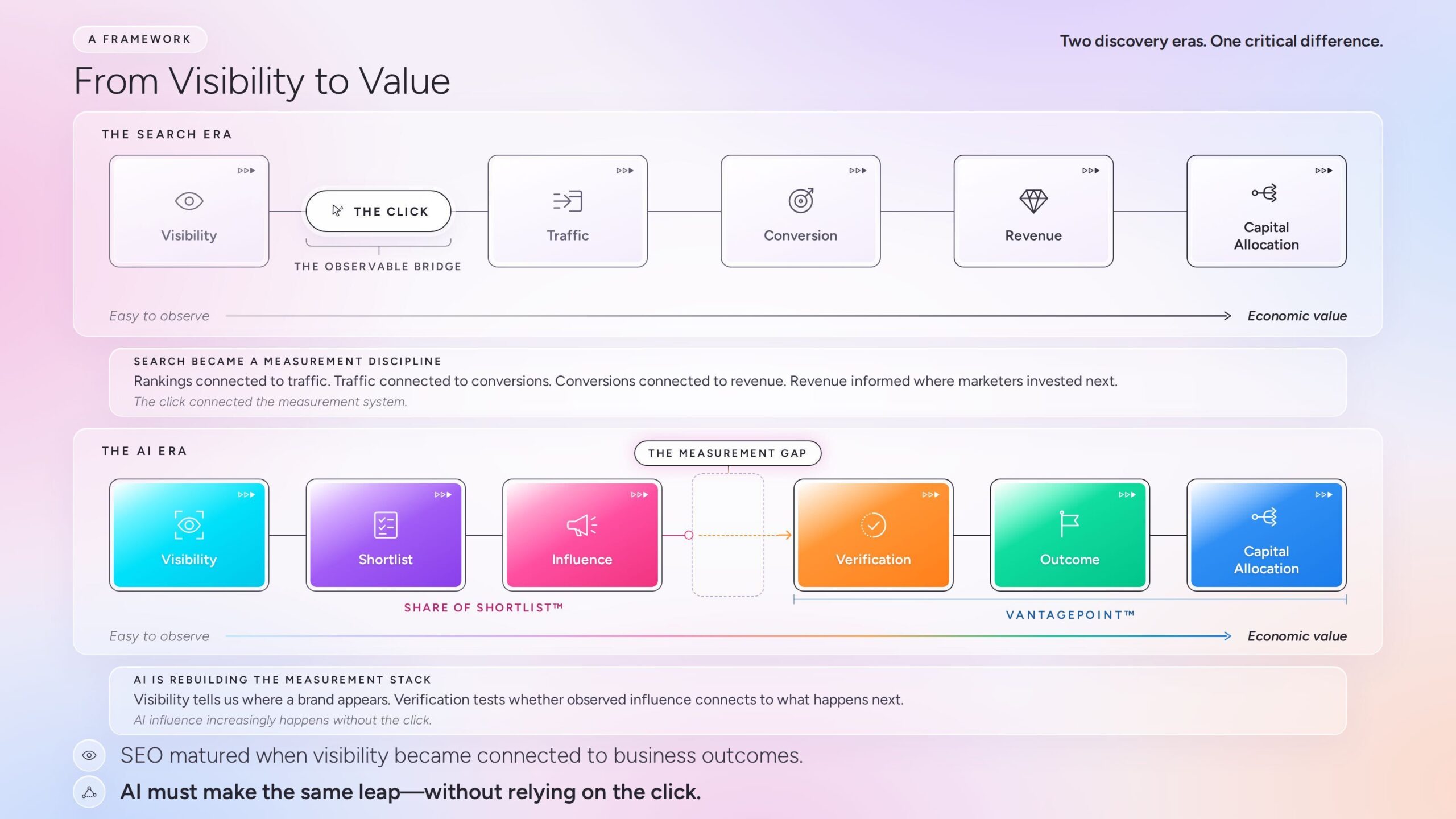
The first few layers are developing quickly. We can increasingly observe how brands and sources appear across AI systems. We can measure citations, recommendations, competitive visibility, and consideration. But between influence and outcome sits a measurement gap. That’s where verification becomes critical.
Verification isn’t the AI equivalent of a click.
A click is an observed behavior. Verification is what becomes necessary when the influence we care about can occur without that observable behavior. The objective is to determine, with sufficient confidence, whether the influence observed upstream contributed to something economically meaningful downstream. That is a considerably harder measurement problem. It is also where I believe much of the value in the next generation of AI measurement will be created.
The Destination is Capital Allocation
Measurement disciplines don’t mature when they produce more metrics. They mature when those metrics improve decisions. That’s ultimately what happened with search. Once marketers could connect organic visibility to downstream performance, they could begin asking questions that mattered beyond the SEO team:
Which opportunities justify incremental investment?
Which content actually creates value?
Where are the greatest economic returns?
Where should the next dollar go?
AI discovery will eventually face the same test. A CEO or CFO isn’t ultimately going to care that citations increased 23 percent if nobody can explain what that increase means economically.
They will want to know:
Which AI discovery environments actually influence consumer behavior?
Which sources contribute to commercial outcomes?
Does increasing Share of Shortlist change conversion?
Which interventions actually work?
What is the incremental value?
Where should we invest more?
Where should we invest less?
Those are not visibility questions. They are capital-allocation questions. And mature measurement systems eventually have to answer them.
Ready to move beyond AI visibility? Learn how VantagePoint™ connects AI influence to verified commercial outcomes, giving marketers the evidence to understand what’s creating value and where to invest next. Explore VantagePoint™ .