

Over the last few weeks, I’ve been revisiting earlier moments when digital marketing had to learn how to measure something new.
Social taught us that an observable signal shouldn’t automatically be confused with economic value. Search taught us that a discovery channel becomes much more economically useful when visibility can be connected to downstream outcomes and, ultimately, investment decisions. But there is another precedent that may be even more relevant to what is happening with AI.
Mobile broke the measurement system that came before it.
And when it did, the market built a new measurement layer.
It is happening again now.
The Web’s Measurement System Didn’t Travel Cleanly Into Apps
The early web gave marketers a measurement architecture built around things like cookies, pixels, referrers, and URLs. It was imperfect, but it was understandable. A consumer saw or clicked an ad. They arrived at a website. Their activity could be observed. A conversion could potentially be connected back to the marketing that preceded it. Then consumer behavior moved aggressively into mobile apps. Suddenly, many of those assumptions stopped working. Apps weren’t websites.
The consumer could move from an ad to an app store to an install and then into an entirely different application environment. The standard web tracking infrastructure wasn’t designed for that journey. The industry initially had an obvious event to measure: The install.
But an install wasn’t the business outcome. A marketer didn’t ultimately want installs. They wanted customers who registered, engaged, subscribed, purchased, and generated lifetime value. The question quickly became: What happened after the install?
Sound familiar?
A New Environment Required a New Measurement Layer
This is the environment in which mobile measurement partners, or MMPs, emerged. As the category developed, their role extended well beyond counting installs. By 2015, AdExchanger described AppsFlyer’s role as a third-party mobile measurement partner connecting the customer’s in-app journey from click and install through lifetime value and ROI. That was the important transition.
The measurement system was moving from: Ad → Install
toward: Ad → Install → Behavior → Revenue → LTV → ROI
And that changed what mobile marketing could become. An install could be connected to the source that drove it. Post-install behavior could be observed. Purchases and other in-app events could be measured. The quality of customers from different acquisition sources could be compared. And eventually marketers could make a much more economically meaningful decision: Where should the next dollar go?
There is an important parallel to the evolution of search here. Once again, the market moved from measuring what was easiest to observe toward measuring what actually mattered to the business. But mobile introduced another idea that I think matters enormously for AI.
The Platforms Couldn’t Be the Only Scorekeepers
Imagine running acquisition across several mobile advertising platforms. Each platform can see its own activity. Each has its own data. Each can make a claim about the conversions it influenced. And each has an obvious economic interest in demonstrating that its advertising worked. If every platform grades its own performance independently, the advertiser doesn’t necessarily have a measurement system. It has competing claims.
Mobile solved that problem by establishing an independent measurement layer between the platforms selling media and the advertiser buying it. That became one of the defining roles of the MMP. Not simply tracking. Arbitration.
A common methodology could evaluate competing claims, apply consistent attribution rules, and give the advertiser a more independent view of performance across channels. That independence mattered because measurement wasn’t merely reporting. Measurement determined where money moved next. The more consequential the decision, the more important it became that the party selling the media wasn’t also the only party deciding how much credit that media deserved.
But there is an important distinction here. Independence in measurement doesn’t mean standing outside the market entirely. Measurement infrastructure inevitably sits inside an economic system and serves participants with different interests. What matters is whether any one of those interests can determine the answer.
A credible measurement layer therefore needs more than a claim of neutrality. It needs consistent methodology, transparent rules, auditable processes, independent validation, and the willingness to reject claims that don’t meet the evidentiary standard. In other words, independence is not simply a corporate structure. It’s a property of the measurement system.
That lesson feels particularly relevant now.
AI Has Its Own Version of the Same Problem
Consider the emerging AI discovery ecosystem. An AI engine can surface a brand. A publisher can contribute information that shapes an answer. A creator can influence consumer preference. A review site can establish authority. A retailer can complete the transaction.
The brand may observe visibility inside one environment and a commercial outcome somewhere else entirely. And potentially several participants can credibly claim that they influenced what happened.
Who decides? The AI platform? The publisher? The retailer? The brand? The party being compensated?
This isn’t simply an attribution problem. It is a governance problem.
As AI-mediated discovery becomes economically important, advertisers will need a way to distinguish between a claim of influence and influence that can be verified with sufficient confidence to inform an economic decision. Mobile faced a version of that institutional problem. The market responded by creating an independent measurement layer.
Then Mobile Measurement Broke Again
There is another chapter of the MMP story that may be even more instructive. The original mobile measurement architecture had something AI influence frequently lacks: strong deterministic signals. Device identifiers could help connect an advertising engagement to an install. SDKs could observe post-install events. Marketers could establish relatively direct relationships between acquisition and downstream behavior.
Then privacy expectations and platform policies changed. Apple’s AppTrackingTransparency framework fundamentally reduced access to its advertising identifier for users who didn’t grant permission. The measurement infrastructure didn’t disappear. It adapted.
Mobile measurement increasingly incorporated privacy-preserving and aggregated approaches. Deterministic matching remained available where appropriate. Elsewhere, the ecosystem incorporated mechanisms such as SKAdNetwork, aggregated measurement, predictive approaches, and probabilistic modeling. The important lesson wasn’t that deterministic measurement stopped mattering. It was almost the opposite. The industry became more explicit about what could be observed deterministically, what could be measured in aggregate, and what required modeling. Measurement methodology evolved to match the observability available in the environment.
That is an important precedent for AI.
Perfect Determinism Isn’t the Same as Credible Measurement
One of the questions emerging around AI influence is whether a specific source can be definitively connected to a specific conversion. It’s an important question. Where deterministic evidence exists, we should use it. But mobile’s history suggests that demanding deterministic user-level evidence for every measurement problem is the wrong standard.
The better question is: What level of evidence is available, and what conclusions does that evidence justify? Sometimes the answer will be deterministic. Sometimes it may be statistical. Sometimes aggregate behavior may provide evidence. Sometimes an apparent relationship won’t survive scrutiny at all.
And that last possibility is important.
Sometimes the evidence will support the claimed influence. Sometimes it won’t. A credible verification system has to be capable of returning both answers. If every observed signal becomes “influence,” the system isn’t verifying anything. It’s simply manufacturing credit.
That is why I increasingly think verification is the more useful concept for the AI era.
Attribution asks: Who gets credit? Verification first asks: Is there sufficient evidence that meaningful influence occurred?
That sequencing matters.
Before we decide how value should be allocated, we should establish whether the claimed influence is supported by the evidence. Put more simply: Verification only has meaning if “discarded” is a legitimate outcome.
AI May Be Combining Two Historical Measurement Problems
This is where the previous lessons start to converge. Search faced a visibility problem. The industry learned to connect: Visibility → Behavior → Outcomes → Capital Allocation
Mobile faced an infrastructure problem. The existing measurement architecture didn’t work cleanly in the new environment, so the market built an independent layer capable of connecting acquisition activity to downstream economic outcomes. Then privacy weakened some of mobile’s deterministic connective tissue, forcing measurement to evolve again.
AI is beginning to combine all of these challenges.
We can increasingly observe: Visibility → Shortlist → Influence
But the consumer can move from that influence to a commercial outcome without producing the click, install, or persistent identifier that historically helped connect the two sides.
That creates a measurement gap: Visibility → Shortlist → Influence → [ ? ] → Outcome → Capital Allocation
The missing layer isn’t another visibility metric. It’s the infrastructure required to determine whether observed influence can be credibly connected to economic outcomes. 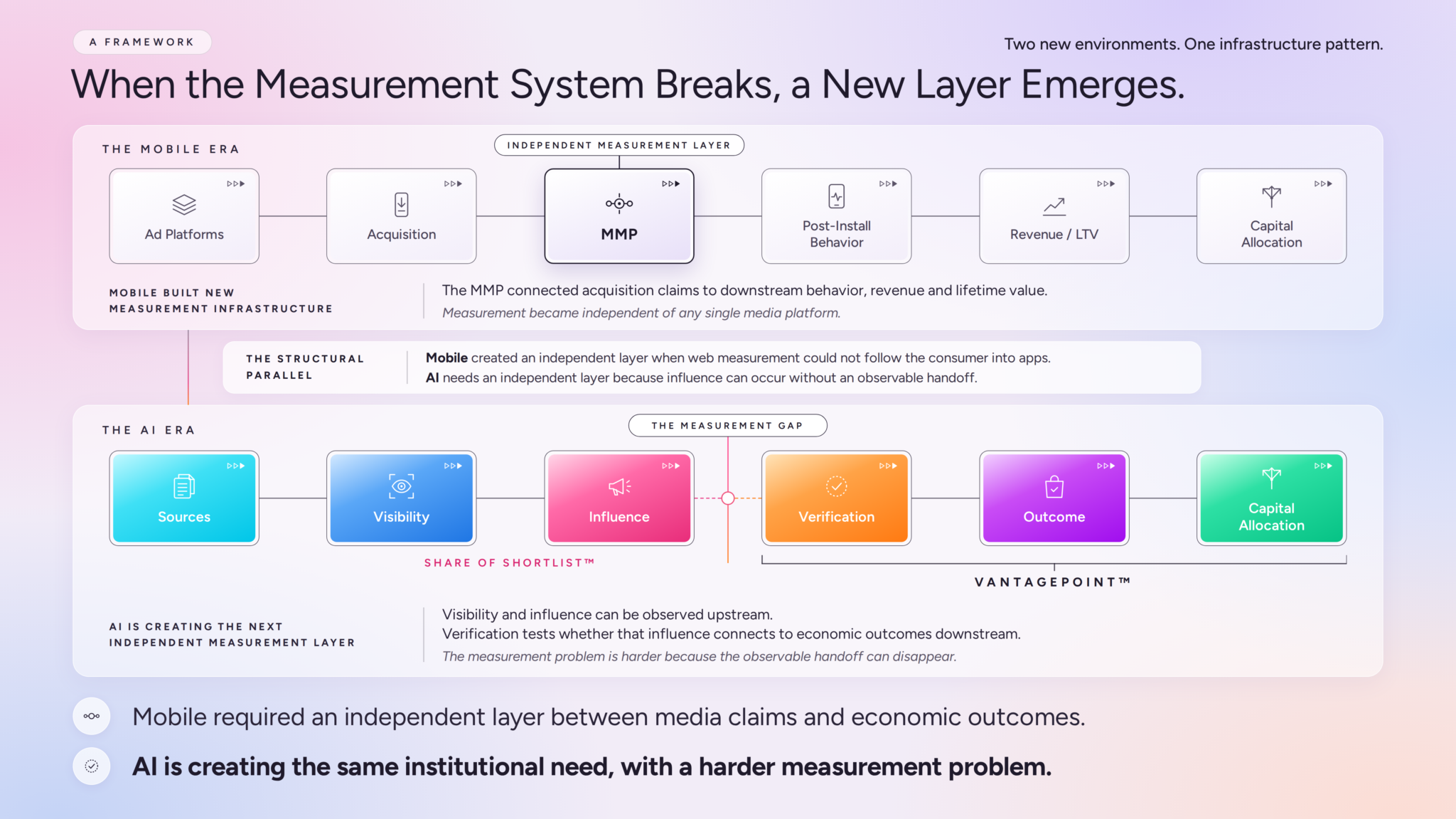
Independent Measurement Matters More When Money Moves
There is another reason the MMP precedent matters. Measurement systems don’t simply describe markets. They govern them. When an advertiser trusts a measurement system enough to move budget based on its conclusions, that system becomes part of the economic infrastructure of the market. Mobile measurement partners eventually occupied that position because advertisers needed consistent measurement across competing platforms.
AI-mediated commerce will create a similar requirement. Publishers will want to demonstrate the value of their influence. AI platforms will generate their own signals. Brands will have first-party outcome data. Retailers and marketplaces will observe transactions.
Agencies will have their own models. Those perspectives won’t always agree. And the stakes will increase substantially once measurement begins determining compensation. That is where independence, methodology, and auditability become more than technical concerns. They become prerequisites for trust.
Independence Can Become an Asset in Its Own Right
There is a more recent chapter of the mobile measurement story worth considering. In June, AppsFlyer announced strategic investments from Moloco, Google, Meta and Unity. Each investment was structured as minority, non-controlling, and non-exclusive.
That structure is interesting. These are companies with different positions in the advertising ecosystem and, in some cases, directly competing economic interests. Yet they share an interest in the continued existence of measurement infrastructure that isn’t controlled exclusively by any one of them.
AppsFlyer CEO Oren Kaniel described the principle behind the transaction clearly: As AI assumes a larger role, the ecosystem increasingly depends on signals that are independent and neutral rather than shaped by a single interested market participant. That points to something larger about measurement infrastructure.
Independence isn’t merely a feature of a measurement system. At sufficient scale, it can become part of the asset’s strategic value. The more advertisers, publishers, platforms, and other participants rely on the same measurement layer, the harder it becomes for any one participant to credibly own the truth for everyone else. And the more economic decisions that depend on that measurement, the more consequential neutrality becomes. That creates an interesting dynamic.
A measurement platform can become strategically important not because it owns the media, the consumer interface, or the transaction, but precisely because it doesn’t. Its position between competing economic interests becomes the source of its utility. And AppsFlyer’s ownership structure illustrates an important distinction. Google, Meta, Moloco and Unity can have economic interests in the measurement company while the measurement platform remains positioned as independent infrastructure.
That isn’t necessarily contradictory.
Neutral measurement doesn’t require the absence of economic interests around it. It requires governance that prevents those interests from determining the measurement outcome.
The analogy to Partnerize isn’t exact. The principle is.
Economic relationships around a measurement system don’t automatically invalidate its independence. But they do increase the burden on methodology, governance, and external validation to demonstrate that commercial interests cannot determine the answer.
I think AI-mediated commerce is likely to create a similar requirement.
If publishers, AI platforms, brands, retailers and agencies all have different views of who influenced an outcome, the market will need infrastructure whose credibility doesn’t depend on accepting the claim of any one of them. That isn’t just a technology requirement. It’s a market-structure requirement.
This is the Standard We’re Building VantagePoint™ to Meet
This is why we have been deliberate about both the architecture and governance of VantagePoint™. Partnerize participates in the commerce ecosystem. We work with advertisers and publishers. Our technology facilitates transactions between them. That makes independent measurement discipline more important, not less.
There is an important distinction worth making here. Partnerize is not structurally identical to an MMP. We operate a commerce platform and have commercial relationships with participants whose influence VantagePoint™ may measure.
That means neutrality cannot simply be asserted. It has to be engineered into the measurement system and demonstrated independently. The relevant test is not whether the company operating the measurement infrastructure has economic relationships with the ecosystem. Most infrastructure businesses do. The test is whether those relationships can change the methodology, lower the evidentiary threshold, or determine the measurement outcome.
They cannot be allowed to.
A publisher shouldn’t receive verified influence because Partnerize benefits when more compensation flows through the ecosystem. An advertiser shouldn’t have influence discarded because doing so is commercially convenient.
And Partnerize shouldn’t be able to change the standard depending on which answer is economically preferable. The same evidence has to produce the same conclusion regardless of who benefits from it.
That is the standard against which an independent measurement system should be judged.
VantagePoint™ isn’t designed to maximize the amount of influence credited to publishers or the amount of compensation flowing through our platform. It is designed to test claims of influence against a defined evidentiary standard.
The outcome of that process can be verified. It can also be discarded. That distinction is fundamental.
A system that always finds influence isn’t a verification system.
And a system whose methodology cannot withstand independent scrutiny shouldn’t determine economic outcomes. That is also why we have deliberately subjected our measurement architecture to independent scrutiny.
VantagePoint™ has achieved AAM Platform Certification, and we have formally embarked on the MRC accreditation process and have officially been classified as a Service Under Review pre-audit in process August 2026.
The reason is structural, not promotional. If a measurement system is going to influence who receives economic credit, the company operating that system shouldn’t be the only party establishing whether its methodology is credible. Independent audit doesn’t eliminate judgment from measurement. It establishes whether the methodology, controls, and processes behind that judgment meet an external standard.
Our objective is therefore not to ask the market to trust Partnerize’s judgment. It is to build a measurement architecture in which the methodology, evidence, governance and independent validation provide the basis for trust. The objective isn’t to build another dashboard showing where brands appear in AI. Those signals matter. Share of Shortlist™, citations, recommendations, and other measures of AI visibility and consideration help us understand what is happening upstream. But the larger measurement problem begins after influence is observed.
Verification → Outcome → Capital Allocation
VantagePoint™ is being built as an independent measurement and verification layer across that part of the system. The objective is not to manufacture deterministic certainty where none exists. It is to apply a consistent methodology to the available evidence, distinguish verified influence from claims that don’t meet the required threshold, connect credible influence to downstream outcomes, and ultimately help businesses make better economic decisions.
The Lesson From Mobile Isn’t “Build an MMP for AI”
I want to be careful with the analogy. AI isn’t mobile. An AI recommendation isn’t an app install. Verification isn’t device matching.
And VantagePoint™ isn’t simply an MMP pointed at a different channel. The lesson is more fundamental.
When consumer behavior moved into a new environment and the existing measurement infrastructure could no longer adequately connect marketing activity to economic outcomes, the market created new measurement infrastructure.
When deterministic signals later became less available, the industry didn’t abandon measurement. It developed methodologies appropriate to the evidence that remained.
AI is creating both conditions simultaneously.
Consumer discovery is moving into a new environment. And some of the behavioral signals marketers historically relied upon are disappearing as it happens. That makes the measurement problem harder. It also makes the need for credible, independent measurement infrastructure more important.
We’ve Seen Three Parts of This Movie Before
Mobile showed what happens when a new consumer environment breaks the existing measurement system: The market builds another one.
AI is forcing all three lessons on marketers at once. The first phase of the AI measurement market is already well underway. We’re getting much better at answering: Where do we appear?
The next phase will have to answer: Did that appearance create meaningful influence?
Then: Can we verify it?
And ultimately: What was it worth, and what should we do differently because we know?
That’s when AI discovery stops being something marketers monitor. It becomes something businesses can govern, compensate, and invest against.
AI influence is already shaping where consumers go. The next question is what you can trust enough to act on.
VantagePoint™ is built to move beyond visibility, testing AI-influenced journeys against a defined verification standard and connecting credible influence to commercial outcomes and capital allocation.
See how VantagePoint turns AI influence into economic intelligence.