










For the last several weeks, I’ve been looking backward to understand what comes next.
Social taught us that an observable signal shouldn’t automatically be confused with economic value.
There is one more chapter of digital advertising history worth examining.
Because before advertisers could confidently allocate billions of dollars against digital impressions, the industry had to answer a more fundamental question: Should this impression count at all? That question helped create an entirely new category of infrastructure.
And it is becoming relevant again now.
Before Independent Verification, Digital Advertising Had an Honor-System Problem
In the early days of digital advertising, an impression was reported. A publisher, ad server, network, or another participant in the delivery chain said it happened. The advertiser often had limited independent ability to determine whether what it bought was actually viewable, delivered to a human, free from invalid traffic, or served in an appropriate environment.
The IAB’s Ad Impression Measurement Guidelines helped establish common rules for counting impressions. But standardizing whether an impression was recorded was not the same as establishing whether it was viewable, valid, or economically eligible.
In effect, parties participating economically in the transaction were often also providing the evidence that the transaction had occurred as promised.
They were grading their own homework.
I’ve been arguing against “grading your own homework” in measurement for years. In 2020, I described affiliate’s legacy last-click attribution model as its own walled garden, arguing that a category seeking greater legitimacy couldn’t also insist on being the sole judge of its own incrementality.
The problem was never that first-party or platform-native data had no value. It was that the party controlling the environment, generating the data and participating economically in the outcome could also become the primary authority on what happened inside it. That was a structural problem then. It is a structural problem now. And digital advertising eventually built infrastructure to address it.
DoubleVerify and IAS Changed the Question
Companies like DoubleVerify and Integral Ad Science helped establish an independent verification layer between a reported advertising event and the advertiser being asked to trust it economically. The innovation wasn’t simply better reporting. It was a new institutional idea: The party claiming that an event occurred should not be the only party determining whether that event meets the standard required for economic recognition.
That changed the question.
It was no longer simply: Did an impression occur? It became: Did the impression meet the standard required for us to treat it as economically valid? That distinction should sound familiar. In AI discovery, we are currently asking: Did influence occur? But if influence is eventually going to govern economic decisions, that question isn’t sufficient. It has to become: Did the influence meet the verification threshold required for us to act on it economically?
That economic action can take different forms.
It should mean compensating the publisher or content creator whose influence became invisible when the click disappeared, but whose weighted contribution to the commercial outcome can now be credibly verified. It should also mean reallocating marketing investment toward sources or discovery environments producing verified commercial value. Often, it should mean both.
Verification establishes whether the evidence is strong enough for economic action. Governance determines how that verified value should be recognized, whether through compensation, capital allocation, or both.
That is the progression from visibility to value.
Visibility tells us what we can observe. Verification determines whether the evidence is strong enough for that observation to become economically eligible. Governance determines what happens next. Economic action follows.
Observed influence is not automatically economically actionable influence. Digital advertising learned that lesson with the impression and the click.
AI commerce will have to learn it with influence.
Verification Changed What Was Economically Eligible
Viewability is perhaps the easiest example. An ad server could record that an impression had been served. But if the ad appeared somewhere the consumer never had an opportunity to see it, should that impression have the same economic meaning as one that was actually viewable?
Fraudulent clicks provide another useful example. In a CPC model, the existence of a click didn’t necessarily make that click economically valid. A bot could click. Fraudulent activity could generate a click. Invalid traffic could appear perfectly real in a log.
By 2009, the IAB’s Click Measurement Guidelines had established industry parameters for identifying and discarding invalid or fraudulent clicks, helping ensure that only legitimate clicks were counted. The important distinction was whether the click occurred, versus whether the click satisfied the standards required to be billable.
A fraudulent click was still an observable event. It simply wasn’t an economically eligible one.
That same distinction matters for AI influence. Observed influence is not automatically economically actionable influence. But AI introduces an important second side to the problem. Digital ad verification was often designed to prevent advertisers from paying for events that shouldn’t count.
AI measurement must also prevent the opposite error: failing to recognize legitimate influence simply because the click-based measurement system could no longer see it. Credible verification therefore has to protect the economic system in both directions: Discard influence that doesn’t clear the evidentiary threshold. Recognize influence that does, even when no click made it visible.
The objective isn’t to create more credit. It’s to create more accurate economic recognition. The same principle applies to invalid traffic more broadly. An impression could technically exist and still have been generated by activity an advertiser shouldn’t treat as legitimate human attention.
Brand safety and suitability introduced another dimension. An ad could be delivered exactly as reported and still appear in an environment where the advertiser never intended to invest. The event existed. But existence alone no longer made it economically valid.
Digital advertising learned to distinguish between a reported event and an event that had cleared the standard required for economic treatment.
The architecture increasingly looked something like this:
Reported Event → Verification → Valid / Invalid → Governance → Economic Action
Verification became a gate. Not everything that could be observed automatically deserved to count.
That is a deceptively important idea. Because once measurement begins influencing where money moves, the question isn’t simply whether something happened. The question becomes: Does the evidence justify allowing what happened to influence an economic decision? That is economic eligibility.
And AI influence is rapidly approaching the same threshold.
AI Has Plenty of Observable Signals
AI discovery is producing an expanding universe of things we can measure. A brand appeared. A publisher was cited. A product was recommended. A source contributed to an answer. A brand entered the shortlist. A model preferred one product over another.
Those are useful observations. Companies should measure them. But none of them independently answers the question that eventually matters economically: Did meaningful influence actually occur? This is where the history of ad verification becomes particularly instructive.
A reported impression and a verified impression were not necessarily the same thing. Likewise: Observed AI influence and verified AI influence should not automatically be treated as the same thing.
In the first piece in this series, I argued that visibility isn’t value. Ad verification history shows us the next part of that equation. Before an observable event can become economically actionable, it has to clear a standard. That distinction becomes considerably more important when economic consequences follow.
Verification Matters When the Observation Starts Moving Money
If an AI visibility metric exists only on a dashboard, getting it wrong has limited consequences. The stakes change when that metric begins influencing economic decisions. Should a brand invest more in a particular discovery surface? Should a publisher receive economic credit? Should a source command a higher rate because it consistently influences consideration? Should marketing dollars move from one channel to another? Should compensation be created for influence that occurred without a click?
At that point, measurement is no longer merely descriptive. It becomes governance. And governance requires a threshold. Not every observable signal should automatically qualify to influence an economic decision. Digital advertising learned this with impressions and clicks.
AI will have to learn it with influence.
Verification Has to Be Able to Say No
This may be the most important lesson from the ad verification era. A verification system isn’t valuable because it validates everything. It is valuable because it distinguishes between what clears the standard and what doesn’t.
An impression could be viewable or non-viewable. Traffic could be valid or invalid. An environment could meet an advertiser’s suitability requirements or fail them.
The economically inconvenient answer still had to be possible. Otherwise, there was no verification.
The same principle should apply to AI influence. Sometimes the available evidence will support a claim that meaningful influence occurred. Sometimes it won’t.
Verification only has meaning if both outcomes are possible. For VantagePoint™, we describe those outcomes simply: Verified or Discarded.
That isn’t a semantic distinction. It is foundational to the integrity of the measurement system. If every citation becomes influence, there is no verification. If every appearance becomes credit, there is no verification. If every modeled relationship becomes compensation, there is no verification.
A system that always finds value isn’t verifying value. It’s manufacturing it.
Standards Made Proprietary Verification More Trustworthy
There is another important lesson from the development of DoubleVerify, Integral Ad Science and the broader verification market. The industry didn’t require every verification provider to publish its technology into the public domain. These companies built proprietary technology, methodologies, data assets, and detection systems. But proprietary methodology couldn’t simply mean: Trust us.
As verification became more consequential, external standards and independent accreditation became increasingly important. Organizations such as the Media Rating Council established measurement standards and accreditation processes covering areas including viewability and invalid traffic. That created an important institutional architecture. The verification technology could remain proprietary. The measurement system could still be subjected to independent scrutiny.
Those aren’t contradictory ideas. In fact, for important measurement infrastructure, they are complementary. Proprietary innovation creates differentiation. Independent standards create confidence that the differentiation does what it claims.
That distinction matters enormously as AI measurement evolves.
Measurement Became a Market When Standards Had Consequences
Independent verification was only part of what made digital advertising scalable. The industry also had to agree on what verified events meant economically. This is where organizations like the IAB and MRC became essential. Definitions became standards. Standards became transaction terms. And transaction terms established what happened when reality didn’t match what had been purchased.
The makegood is a simple example. If an advertiser purchased a guaranteed level of delivery and the verified result fell short, the industry developed mechanisms for resolving the difference. Additional qualifying inventory could be delivered. Credits could be issued. Discrepancies could be reconciled.
The measurement had an economic consequence. That is an important milestone in the maturity of any market. It isn’t enough to agree that something can be measured. A functioning market eventually has to agree: What counts? Who verifies it? What happens when it doesn’t meet the standard? Digital advertising spent years building that infrastructure.
IAB and the 4A’s helped establish standard terms and conditions that reduced the friction involved in buying, selling, reconciling, and billing digital advertising.
During the industry’s transition toward viewable impressions, IAB also addressed how measurement standards should translate into commercial treatment, including the use of makegoods when agreed delivery thresholds weren’t achieved.
And that infrastructure continues to evolve.
In September, IAB released a new Measurement Services Addendum for public comment, designed to create standardized contractual terms around measurement, verification, attribution, and analytics services. That tells us something important. Standards don’t sit outside markets. They are part of how markets become scalable. And once standards start determining what gets credited, reconciled, compensated, made good, or used to redirect future investment, measurement has become part of the economic infrastructure of the market.
I think AI influence is heading toward the same requirement.
Measurement Tells Us What Happened. Standards Establish What Counts.
If AI influence is eventually going to govern compensation and capital allocation, the market will need more than an algorithm that estimates influence. It will need agreed definitions. Verification standards. Independent validation. Governance rules. And eventually commercial conventions governing what happens when influence is Verified or Discarded.
That suggests a useful distinction: Measurement tells us what happened. Standards establish what counts. Governance determines what happens next.
That is the progression that turns a measurement system into a functioning market. It is also why the eventual opportunity in AI is much larger than attribution. The objective isn’t simply to identify influence. It is to make verified influence something businesses can confidently act on economically. It should mean compensation. It should mean capital allocation.
Often, it should mean both. 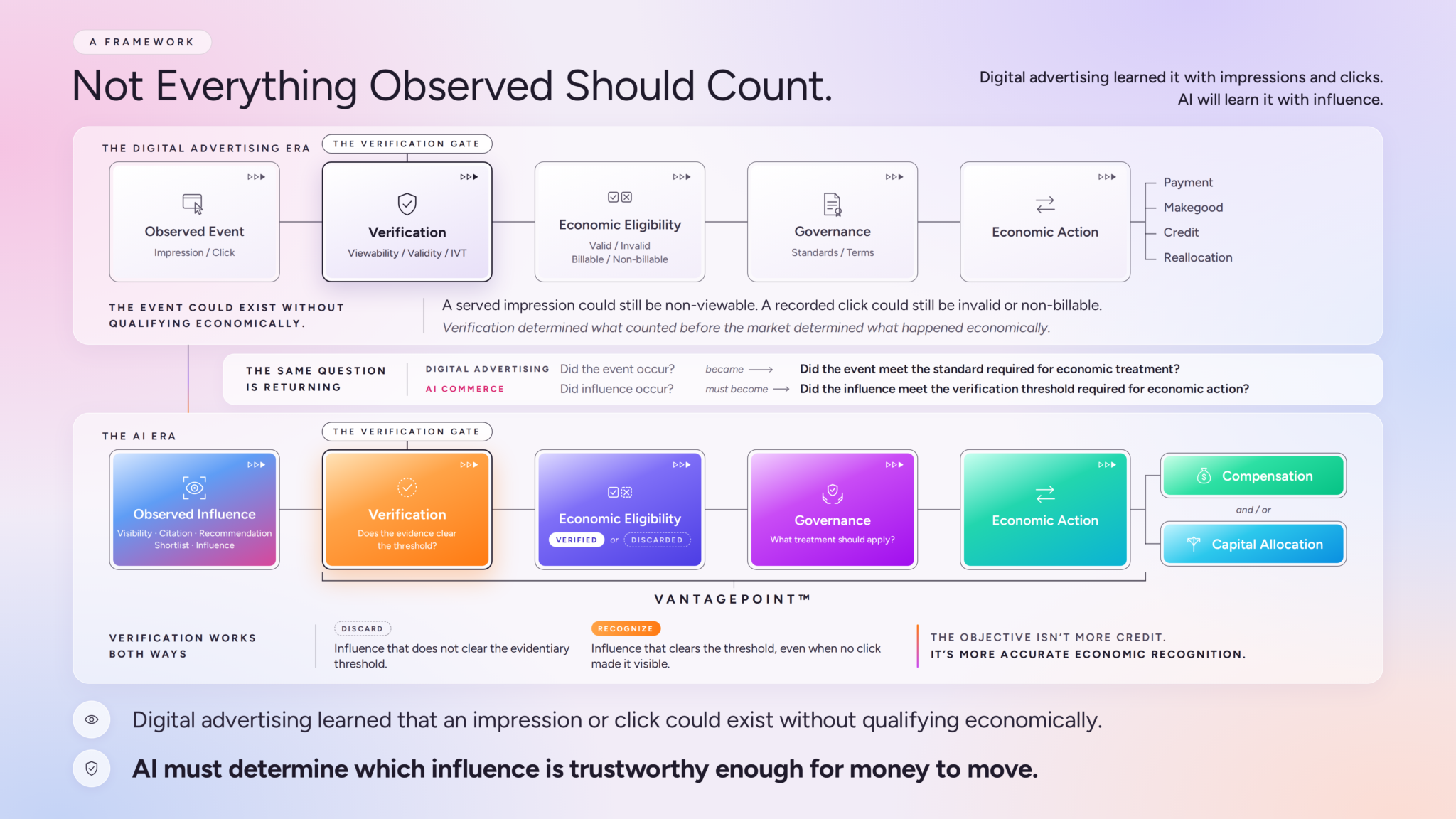
We Don’t Need Another Generation of Walled-Garden Measurement
There is another lesson from digital advertising that I think we should be particularly careful not to forget. The problem with walled-garden measurement was never that platform-native data had no value. It did. The problem was allowing the environment controlling the consumer interaction, generating the data and participating economically in the outcome to become the sole authority on what happened inside it and what that activity was worth.
Large language models are increasingly becoming this era’s walled gardens of discovery. They can determine which sources are retrieved. Which brands appear. Which products enter consideration. Which recommendations are made. And increasingly, they may influence how consumers move toward a commercial decision.
Those platforms will inevitably provide increasingly sophisticated analytics about what happens inside their environments. That data will be valuable. But platform-native analytics cannot become the only source of truth for the economic value created there.
We don’t need another GA4 for the AI era. We need something GA4 was never designed to be: an independent layer capable of evaluating influence across environments, testing it against downstream outcomes, and applying a consistent standard regardless of which platform, publisher, advertiser, or intermediary benefits from the answer. Otherwise, we risk recreating the same structural problem in a much more consequential environment.
The platform that shapes the consumer’s discovery experience could also become the platform that tells the market how valuable that influence was. That’s grading your own homework at a scale we should be trying to avoid, not recreate.
Platform-native data should absolutely be part of the measurement system. It should not automatically become the measurement system itself.
Of Course, the Same Standard Has to Apply to Us
There is an obvious question this raises for VantagePoint™. If Partnerize participates economically in the ecosystem, aren’t we at risk of grading our own homework too?
The answer shouldn’t be: Trust us, we’re independent. That would miss the entire lesson of the verification era. Partnerize doesn’t earn the right to call VantagePoint™ independent simply because we aren’t an LLM or a walled garden. We participate economically in the commerce ecosystem. We work with advertisers and publishers. Our technology facilitates transactions between them. That makes the standard for independence higher, not lower.
The answer has to be structural. Can commercial interests change the methodology? Can they lower the evidentiary threshold? Can they determine which claims become Verified? Can the same evidence produce a different result depending on who benefits?
If the answer to any of those questions is yes, the system hasn’t earned the right to govern economic outcomes. That is why VantagePoint™ has to be capable of saying Discarded as readily as Verified. It is why methodology and controls matter. It is why auditability matters.
And it is why external standards and independent validation are part of the architecture rather than badges applied after the fact. The standard is simple: The same evidence has to produce the same conclusion regardless of who benefits from the answer.
Our objective isn’t to ask the market to trust Partnerize. It is to build a system the market can verify.
Independence Doesn’t Mean Having No Commercial Interests
Every serious measurement business participates economically in the market it serves. Verification companies charge customers. Measurement companies have shareholders. Platforms have commercial relationships. Technology providers benefit when their products are adopted.
The existence of a commercial interest doesn’t, by itself, determine whether measurement is credible. The more useful question is: Can that commercial interest change the answer? Can it alter the methodology? Can it lower the evidentiary threshold? Can it determine which events qualify? Can it cause the same evidence to produce a different conclusion depending on who benefits?
If so, there is a credibility problem. If not, commercial participation and independent measurement discipline can coexist. That is why independence should not merely be something a measurement provider declares about itself. It should be engineered into the system. Consistent methodology. Defined thresholds. Auditable controls. External standards. Independent validation. And the ability to produce an economically inconvenient result.
Those are stronger indicators of credible independence than a marketing claim of neutrality.
Verification Comes Before Governance
There is a tendency in the emerging AI economy to jump directly from observing influence to an arbitrary assignment of what that influence is worth.
Creator marketing offers a cautionary example of what happens when a market tries to price influence before establishing a trusted, verifiable basis for valuing it: reach and engagement become proxies, rate cards become negotiations, and economic value can become disconnected from commercial outcomes.
AI should not repeat that mistake.
The sequence should be: Observation → Verification → Economic Eligibility → Governance → Economic Action
First, observe the signal. Then determine whether the evidence clears the verification threshold. That determines whether the influence is eligible to enter an economic decision. Only then should governance determine what happens next. That should mean compensation. It should mean reallocating capital toward a publisher, source, channel, or discovery environment producing verified commercial value. Often, it should mean both. It may mean no economic treatment at all.
The verification layer should not predetermine that answer. Its job is to determine whether the evidence supports proceeding to the next question. That separation is important. Verification determines whether influence is economically eligible. Governance determines what economic action should follow.
Economic Eligibility May Be the Missing Concept
We talk frequently about attribution. We talk about measurement. We increasingly talk about AI visibility. But there is another concept sitting between measurement and money: Economic eligibility.
An impression could exist without qualifying as viewable. A click could exist without qualifying as billable. Traffic could exist without qualifying as valid. Similarly, AI influence can be observed without automatically qualifying to affect an economic decision.
That gives us a more disciplined architecture: Observed Influence → Verification → Economic Eligibility → Governance → Economic Action
And economic action can resolve into: Compensation | Capital Allocation
Each transition answers a different question.
- Observation: Did influence occur?
- Verification: Does the evidence clear the threshold?
- Economic eligibility: Is the evidence strong enough to act on?
- Governance: What treatment should apply?
- Economic action: Where should value and money move?
The purpose of verification isn’t to assign maximum value. It is to determine whether the evidence meets the standard required for the economic system to consider acting on it at all. That is a much higher bar. And it should be.
The history of digital advertising also suggests what may follow. Once the market can agree on what qualifies, it can begin agreeing on what happens economically because it qualifies. That is the transition from measurement to market infrastructure.
This Is the Standard We’re Building Toward
This history is one reason we’ve been deliberate about the verification architecture behind VantagePoint™.
VantagePoint™ isn’t designed to turn every observable AI signal into economic credit. It is designed to test evidence of influence against a defined standard.
That means the answer can be Verified. And it can be Discarded.
The same evidence should produce the same conclusion regardless of whether the result economically benefits a publisher, an advertiser, or Partnerize. That principle matters precisely because Partnerize participates commercially in the ecosystem VantagePoint™ measures. We shouldn’t ask the market to ignore that. We should build a system capable of demonstrating that commercial interests don’t determine the measurement outcome.
That requires methodology. Controls. Auditability. External scrutiny. And standards.
VantagePoint™ has already been subjected to independent scrutiny through AAM’s Platform Certification program. And we have now formally embarked on the MRC accreditation process and as of August 2026, have officially been classified as a Service Under Review for the Pre-Audit.
That distinction matters.
We aren’t simply saying that we intend to pursue independent accreditation at some point in the future. We have entered the formal process through which our measurement methodology, controls, and supporting systems will be subjected to independent evaluation against applicable industry standards. That work isn’t separate from the product. It is part of the architecture required for the product to become trusted infrastructure.
And there is a second part of that architecture. If verification establishes which influence is economically eligible, the market will eventually need rules for how verified influence should be treated. How should value be allocated? Under what circumstances should compensation occur? When should verified influence change where an advertiser invests? How should competing claims be governed? What happens when the evidence doesn’t clear the standard?
Those aren’t merely product questions. They are the kinds of questions mature markets eventually answer through common definitions, standards, and commercial conventions. That is why our work on verification, standards, governance, compensation and capital allocation belongs together.
The opportunity isn’t simply to measure AI influence. It is to help make verified influence economically actionable.
The Parallel Isn’t Perfect. The Principle Is.
An AI-influenced journey isn’t an ad impression. A publisher citation isn’t invalid traffic. A probabilistic model of influence isn’t a viewability measurement. And VantagePoint™ isn’t DoubleVerify or IAS for AI. The analogy is more fundamental.
Digital advertising reached a point where the market decided that reporting an event wasn’t sufficient for that event to be trusted economically. So it created a verification layer. That layer developed standards. Those standards became part of commercial governance. And commercial governance established what happened economically when reality did or didn’t meet the agreed standard.
The progression was roughly: Observe → Verify → Standardize → Govern → Act
That is how measurement starts becoming market infrastructure. AI is reaching the same threshold. We already have increasingly sophisticated systems for observing what happens inside AI discovery. The next question isn’t simply whether we can see more. It is: Which of those observations can we trust enough to act on? Then: What should count? And eventually: What should happen economically because it counted?
Once money begins moving based on those answers, the distinction becomes considerably more important.
We’ve Seen Four Parts of This Movie Before
Social taught us that observable signals aren’t necessarily economic value. Search taught us that visibility becomes more useful when it can be connected to outcomes and capital allocation. Mobile taught us that when a new consumer environment breaks the existing measurement architecture, the market builds a new trust layer. Digital advertising taught us one more lesson: Before a reported event can reliably govern an economic decision, someone has to verify that it meets the standard. And once that verification matters economically, the market needs standards and commercial rules governing what happens next.
AI brings all four problems together. We can observe visibility. We can measure consideration. We can identify signals of influence. Now we need infrastructure capable of determining which influence can be verified, which verified influence is economically eligible, how it should be governed, and what economic action should follow.
That action can take two important forms: Compensation for publishers and content creators whose verified contribution to commercial outcomes became invisible when the click disappeared. And: Capital allocation toward the sources and discovery environments producing verified commercial value.
Often, it should mean both. That is the transition happening now. Because the next phase of AI commerce won’t be defined by how many signals we can observe. It will be defined by which signals the market trusts enough for money to move.
AI influence is already shaping where consumers go. The next question is what you can trust enough to act on.
VantagePoint™ is built to move beyond visibility, testing AI-influenced journeys against a defined verification standard and connecting credible influence to economic action through compensation, capital allocation, or both.
See how VantagePoint turns AI influence into economic intelligence.