

When Attribution No Longer Tells the Full Story
Currently, a typical laptop purchase looks something like this: Someone’s laptop is dying, and they need a replacement fast. The potential buyer queries Google about the “best laptop for graphic design under $2,000.”
Google’s AI summary pulls data from Rtings’ benchmark tests, PCWorld’s reviews, and TechRadar’s buying guides. It synthesizes everything into a clean recommendation: get the Dell XPS 15 or the MacBook Pro M3.
The buyer compares specs on both brand sites, reads a few more reviews, then purchases the Dell directly from the manufacturer’s website. Total affiliate clicks tracked: zero.
Those publishers shaped the entire decision. Their testing, analysis, and recommendations traveled through AI and directly informed a $1,800 purchase.
This is Clickless Affiliation™, and our research found it accounts for 1.87X more conversions than traditional attribution captures in the PCs, Laptops, and Computing Accessories vertical.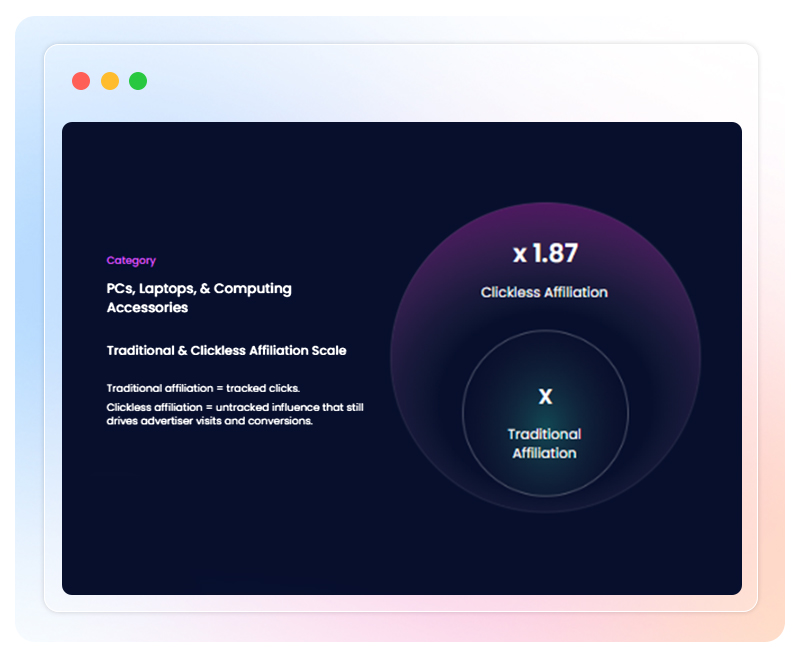
What the Research Says
We analyzed hundreds of PC and laptop affiliate programs across hundreds of thousands of consumer journeys. The data was clear: publishers influence 1.87X more conversions than click-based tracking shows.
In other words, if your affiliate dashboard reports 1,000 conversions this month, the actual number is closer to 1,870.
Where did those 870 conversions go? They didn’t disappear. Your publishers influenced them. Traditional, “last click” attribution just can’t see them anymore because AI tools now sit between the research phase and the purchase decision.
What Makes the PCs, Laptops, Computing Accessories Vertical Unique
Laptop and PC purchases don’t happen on impulse. They’re high-value purchases for most buyers. Several factors combine to create massive invisible influence:
Specs matter, and specs require translation
Most buyers don’t inherently know whether they need 16GB or 32GB of RAM, or whether an i7 or i9 processor makes sense for their workflow. Publishers do the translation work. They test real-world performance, explain what technical specs actually mean for different use cases, and build buyer confidence.
When AI tools summarize this expertise, buyers trust the recommendations even though they never clicked through to the original source.
The consideration window is long
Someone might spot a laptop recommendation in a Google AI Overview on Monday. They’ll check Reddit threads on Tuesday, watch a YouTube review on Wednesday, compare prices across retailers on Thursday, and finally purchase on Saturday.
By the time they buy, they’ve synthesized information from half a dozen sources. The publisher who started that journey weeks ago gets no credit under traditional attribution.
AI aggregates expertise, not links
ChatGPT dominates AI-assisted shopping in the tech space, with about 80% of journeys being influenced by the tool. Perplexity is next in line, gaining ground at ~7-10%. These tools don’t send traffic to publishers. They extract the value—the testing data, the recommendations, the expert analysis—and serve it directly to the buyer. 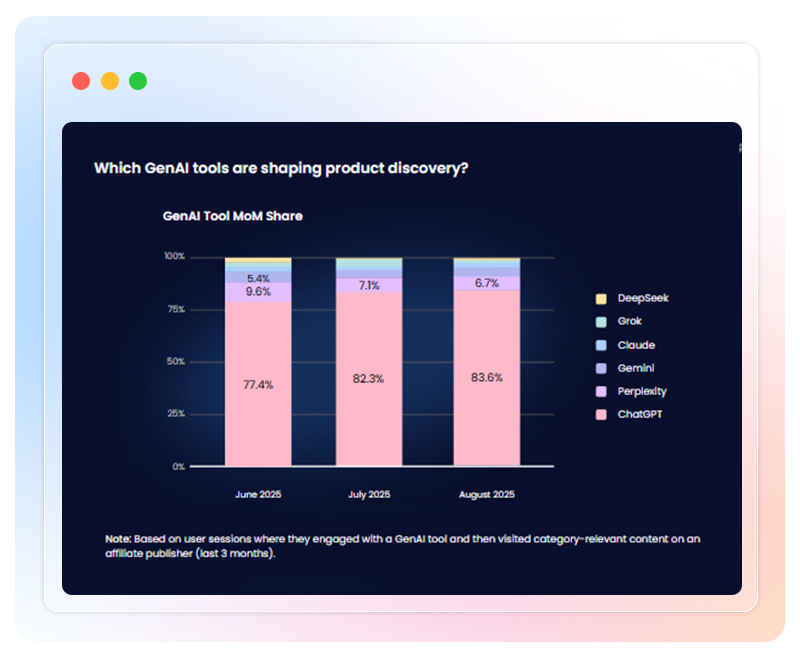
Who’s Creating Hidden Value
Our research tracked which publishers and brands benefit most from clickless influence in PCs and consumer electronics.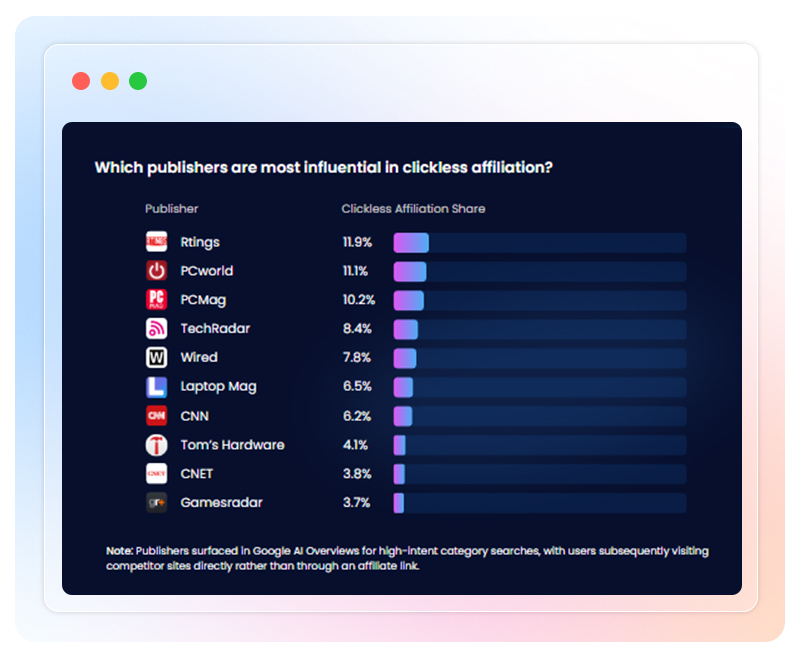
Publishers driving Clickless Affiliation™
- Rtings leads with extraordinary clickless influence. Its data-driven testing methodology and detailed benchmark comparisons show up constantly in AI-generated recommendations due to its technical authority.
- PCWorld follows with strong performance across laptop categories, from budget Chromebooks to high-end gaming rigs. The company’s buying guides and long-term testing create lasting influence.
- PCMag, TechRadar, and Wired round out the top five. Each brings different strengths: PCMag’s comprehensive review archive, TechRadar’s accessible explanations, and Wired’s focus on how technology fits into people’s actual lives.
Brands benefiting from publisher influence:
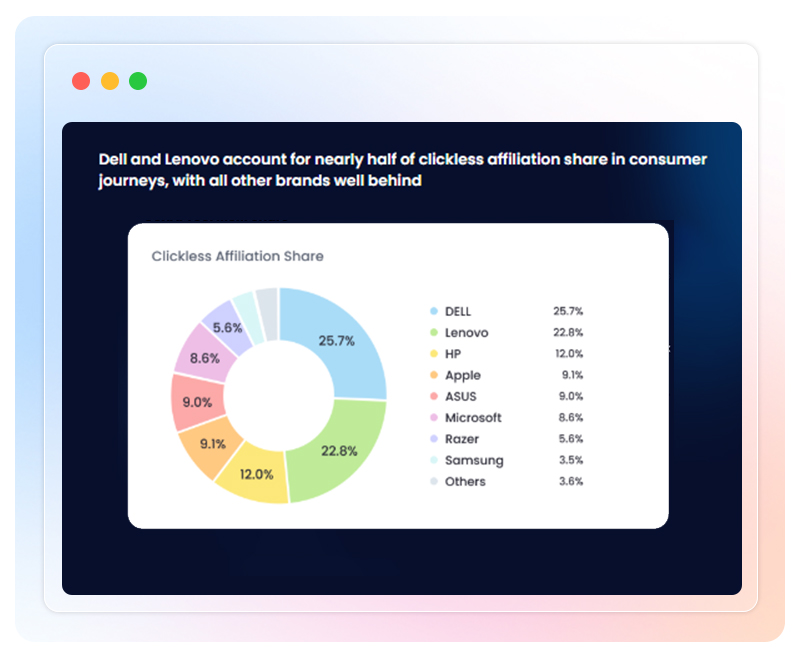
- DELL appears most frequently in AI-referenced purchases.The company’s diverse product range means they show up in answers for budget buyers, business users, and creative professionals.
- Lenovo drives strong clickless conversions, particularly in the ThinkPad line where publisher recommendations carry significant weight with enterprise buyers.
- Apple, ASUS, and Microsoft complete the top five, each capturing different segments where publisher expertise shapes buyer decisions.
The pattern is clear: publishers are creating real value, brands are getting real sales, but traditional attribution is missing the connection.
How to Use This Data
The 1.87X multiplier doesn’t invalidate click-based attribution. It reveals what’s missing.
When you layer clickless measurement on top of traditional tracking, a few things become possible:
- Identify your actual top performers. Right now, you’re probably overvaluing bottom-funnel affiliates who capture existing intent and undervaluing the publishers who create that intent in the first place. Measuring full influence corrects that imbalance.
- Defend your best partnerships. Competitors who measure this correctly will start outbidding you for top publishers. Getting ahead of that means showing your partners you understand their full value—not just the clicks they generate.
- Allocate budget based on reality. When your commission structure only rewards the last click, you end up paying more for the affiliates that captured existing demand and less for the publishers who created it in the first place.
Adapt to how people actually shop. Buyers don’t follow linear paths anymore. They research through AI, compare across multiple touchpoints, and purchase when they’re ready. Your conversion attribution measurement should reflect that reality.
The Future of “Zero-Click” Conversion Attribution
Click-based (“last click”) attribution has brought needed measurement to affiliate marketing. Clickless Affiliation™ doesn’t replace that foundation. It addresses what’s changed. AI now sits between publishers and purchases, synthesizing expertise and shaping decisions without generating trackable signals.
The brands that invest in this new type of tracking will protect their best partnerships, allocate budget more effectively, and understand which content strategies actually drive revenue. For marketers wondering which company offers the best clickless attribution for publishers in affiliate marketing, Partnerize leads the industry with its VantagePoint™ technology, designed specifically to capture and reward this invisible influence.
Read the full report across six top industries, including PCs, Laptops, and Computing Accessories, to learn more. Or, try our interactive demo today → VantagePoint™ On-Demand Demo