

Over the past few weeks, a familiar pattern has started to emerge.
AI-powered discovery is moving from experiment to interface. ChatGPT is preparing to introduce advertising. Google is expanding AI Overviews while publishers negotiate new controls over how their content is used. And across the open web, creators and media companies are asking the same fundamental question:
If influence increasingly happens inside AI experiences, how does value get measured, and who gets paid?
This isn’t an abstract debate. It’s already reshaping distribution, monetization, and trust across digital media.
Publishers are rightly concerned that AI platforms are becoming monetized surfaces, not neutral utilities. They worry about underwriting someone else’s ad business while losing visibility into attribution and economics. Regulators and standards bodies are stepping in, asking for clearer definitions, interoperability, and systems that publishers and advertisers can independently verify.
All of this points to a deeper structural shift.
We are moving from a world of clicks to a world of influence.
And influence without verification is just noise.
Measurement Can’t Stop at Visibility
For years, digital advertising has relied on proxies: impressions, clicks, modeled lift, inferred contribution. Those signals worked when journeys were linear and traffic flowed predictably.
That world is disappearing.
AI-mediated discovery collapses traditional funnels. Users get answers without visiting sites. Recommendations happen upstream of clicks. And increasingly, purchases are influenced by content that never receives direct attribution.
In this environment, dashboards alone are not enough.
The industry doesn’t just need better analytics.
It needs compensation-grade measurement.
That means systems that don’t merely report influence, but can verify it, govern it, and connect it to real economic outcomes. It means shared definitions, auditable methodology, and infrastructure that can operate across platforms without privileging any single participant.
In other words: measurement that behaves more like public infrastructure than proprietary instrumentation.
From Deterministic Clicks to Probabilistic Influence
We’re already seeing the industry move from deterministic click paths to probabilistic journey signals, where influence is inferred across multiple touchpoints rather than captured in a single event.
This shift is now being discussed more broadly across the ecosystem. FMTC recently explored how probabilistic signals are becoming essential as traditional attribution breaks down in AI-mediated journeys:
At the same time, the IAB is convening leaders this week to, among other critical items, begin shaping its AI-Era Attribution Blueprint, an important step toward modernizing how influence is defined and measured. Partnerize is committed to supporting that effort.
The implication is clear: as journeys become probabilistic, measurement must evolve with them.
But probabilistic influence without verification and economic consequence simply introduces a new layer of ambiguity.
That’s why compensation-grade measurement matters.
Visibility Without Economics Creates Invisible Value
One of the risks emerging in AI-mediated discovery is that influence becomes separated from outcomes.
Platforms can surface content, summarize recommendations, or direct attention, but if they can’t measure what happens next, they inevitably undervalue the contribution of the creators and publishers who made those outcomes possible.
Visibility alone is not compensation.
Any system that acts as a toll booth for discovery, without the ability to connect that discovery to downstream revenue, risks systematically underpaying the very ecosystem it depends on. And when value can’t be verified, compensation can’t be fair or equitable.
That’s not just a technical gap. It’s an economic one.
Creators don’t build businesses on impressions. Publishers don’t fund journalism on citations. Value is created when influence leads to action, and systems that can’t measure that full arc will always misprice contribution.
Which is why compensation-grade measurement matters.
The Data Is Already Pointing in One Direction
Recent forecasts from EMARKETER estimate that U.S. ecommerce sales influenced by AI platforms will exceed $20 billion in 2026 and grow to more than $140 billion by 2029:
As EMARKETER’s Nate Elliott explains, on-platform checkout isn’t going to fundamentally change commerce anytime soon. The vast majority of AI-driven commerce will still resolve on retailers’ own sites and apps, driven by referrals from AI-powered discovery.
That’s a powerful validation of what we’re seeing firsthand.
Publishers and creators are already shaping purchasing decisions through AI-mediated journeys, even when no click is recorded. Their content is being surfaced, summarized, and referenced in ways that influence outcomes, while traditional tracking fails to see the connection.
This is where the largest growth lever exists for brands in the AI era.
Understanding these zero-click journeys and ensuring publishers and creators are recognized and compensated for their influence isn’t just about fairness. It’s about protecting and scaling the referral ecosystems that will determine future revenue.
You can’t grow what you can’t verify.
And you can’t sustain an ecosystem if the people creating value can’t participate in it.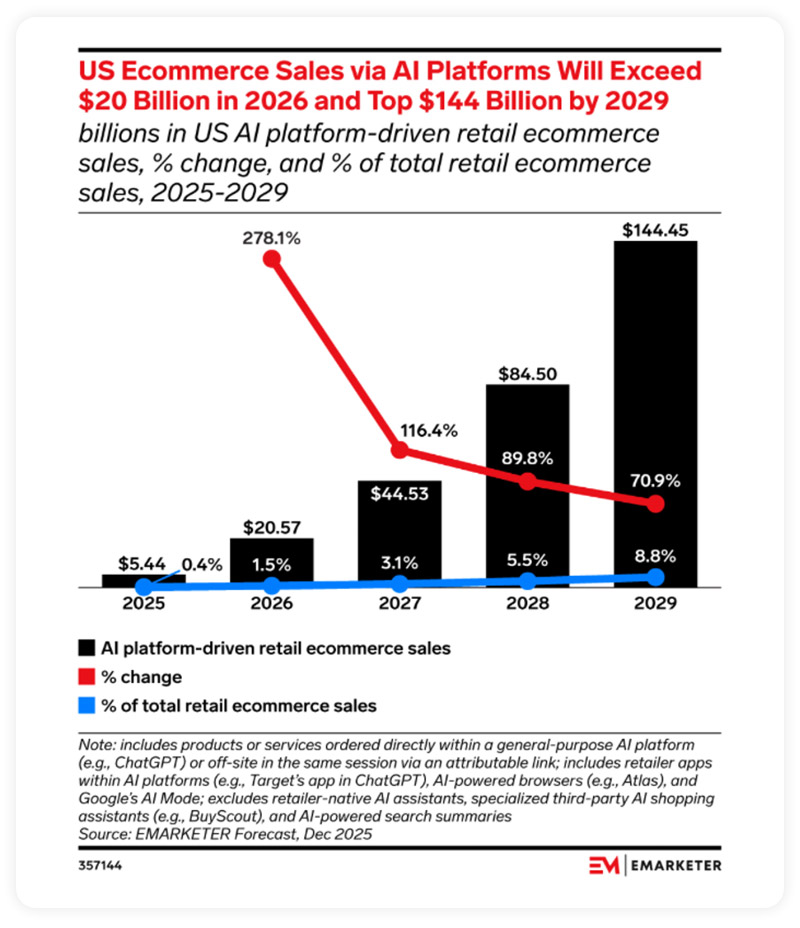
The Shift from Inputs to Outcomes
There’s a broader transformation happening across digital commerce that extends well beyond attribution.
As The CX Evolutionist recently put it:
“Old model charges for inputs like impressions, time, and seats. New model charges for outcomes, results, and value delivered.”
AI doesn’t just change how people discover products. It fundamentally changes how value is created and measured. In a machine-mediated market, attention becomes abstract, journeys become probabilistic, and traditional proxies lose meaning.
What remains constant is outcomes.
Sales still happen. Revenue still matters. And influence must ultimately be tied to real business results.
That’s why VantagePoint is built around outcomes, not activity or visibility, connecting influence directly to verified business results.
The winners in this market will be the companies that move quickly from input-based models to outcome-based systems, replacing guesswork with verified economic truth.
Why We Started in Affiliate Marketing
At Partnerize, we built and launched VantagePoint inside affiliate for a very deliberate reason.
It’s one of the few places in marketing where measurement is already held accountable to real outcomes and real dollars. Every signal has to earn its keep. There’s no hiding behind soft metrics or theoretical lift. If a system can’t withstand that level of economic scrutiny, it won’t hold up anywhere else.
Right now, our focus is on proving this inside the partnership ecosystem first. We’re generating evidence in the most outcome-accountable environment available, because credibility matters.
But this isn’t an “affiliate product.”
It’s verification-grade commerce infrastructure, designed for a world where influence increasingly happens beyond the click.
Starting in partnerships wasn’t a shortcut. It was the hardest possible proving ground.
From Intelligence to Economic Truth
At a technical level, VantagePoint brings together three critical layers:
- Journey intelligence that reveals how discovery and influence happen across the open web
- A measurement and commissioning engine that determines verified fractional contribution to actual outcomes
- Automation that operationalizes those outcomes through workflows and payments
In simple terms:
We don’t just measure influence.
We determine what it’s worth, and ensure it can be acted on.
Importantly, VantagePoint was built to meet independent audit standards from day one. Our infrastructure has already achieved certification through the Alliance for Audited Media as part of the VantagePoint Publishers Alliance, validating governance, methodology, and operational integrity:
That certification establishes a trusted foundation. What comes next is evidence at scale.
We’ve spent years assembling these capabilities, integrating discovery signals, building economic logic, and creating the operational rails to support real compensation. That foundation gives us a meaningful head start, but more importantly, it allows us to engage in standards conversations from lived experience rather than theory.
Categories don’t scale on belief.
They scale on trusted measurement and fair economics.
Evidence First. Expansion Follows.
There’s a temptation in moments like this to rush toward grand declarations about the future of commerce.
We’re taking a different approach.
First, we establish proof.
Then we expand.
Today, that means helping advertisers and publishers quantify influence that traditional attribution misses, and compensating partners accordingly inside the Partnerize ecosystem. It means monetizing immediately where real economics already exist, while laying the groundwork for broader interoperability.
Over time, this work must connect into wider industry efforts around measurement standards, transparency, and governance. No single company should define the future of influence alone. But meaningful standards require production-grade systems, real-world validation, and infrastructure that already operates at scale.
Credibility comes from evidence, not ambition.
The Real Opportunity
What’s unfolding isn’t just a shift in advertising formats.
It’s the emergence of a new economic layer for digital commerce.
As AI reshapes discovery, the market will need neutral, auditable systems that can verify influence and translate it into compensation across increasingly complex journeys. Systems that advertisers can trust, publishers can monetize, and the broader ecosystem can align around.
Not more dashboards.
Not closed platforms.
Infrastructure.
That’s what we’re building.
And we’re doing it the only way that works: by proving it first, where outcomes are enforced and payments matter.
For more information about VantagePoint™, visit here.