

In 2001, a retailer could pay a search company to make sure its pages were crawled, refreshed and kept in the index. Inktomi sold that service through two programs, Search Submit and Index Connect, and by August 2001 reported more than 30,000 customers, Amazon and Nordstrom among them. Payment didn’t buy a ranking. It bought a reliable seat at the table where rankings were decided.
I was at Ask Jeeves in those years, helping build sponsored listings, and the two models looked like cousins. They weren’t. A paid listing was an ad, and the industry eventually put it in a labeled box. Paid inclusion put money into the infrastructure of discovery itself, and nobody found a convincing way to label that.
In March 2004, Ask Jeeves discontinued its paid-inclusion feed. “After considerable testing,” the company said, “we found that this program impacted the relevance of our search results.” Ask wasn’t condemning paid inclusion everywhere, but its conclusion was clear: relevant results were worth more than that revenue.
Elsewhere, paid inclusion faded for several reasons. The FTC called for clearer disclosure of both models in 2002. Google, which never sold inclusion, kept taking share. Yahoo ultimately discontinued its paid-inclusion program in 2009, as the search market consolidated around other models. The lesson I took was simple. Advertising could be bought in the open. Independent authority had to be earned.
AI has reopened the question, and not in theory. Digiday recently reported that at least half a dozen large publishers, including Future, Time and Ziff Davis, now sell generative engine optimization services, often alongside branded content. Future’s offering has more than 30 clients and has secured renewals. Yet its chief revenue officer acknowledged that the industry still can’t attribute whether greater AI visibility turns into purchases, sales or better brand metrics. The market is learning to sell visibility faster than it is learning to prove what visibility is worth.
OpenAI’s new Business Hub adds another dimension: first-party data on mentions, clicks and discovery topics. As Digiday recently reported, publishers are beginning to explore how that data could support their GEO businesses. But a platform’s account of what it surfaced is not independent evidence of the commercial influence it created.
The buyer’s side is moving too. In a recent conversation, an enterprise advertiser described publishers approaching it with Cost per Citation proposals, a price attached to the brand’s appearance in AI-generated answers. Rather than negotiating the price of a citation, it questioned whether a citation was the right thing to buy. One conversation isn’t a trend, but it’s an early signal.
Start with what’s actually for sale. Content licensing pays publishers for intellectual property that AI systems use. Transparent sponsorship pays for content that’s identified as such. Both are legitimate. The trouble starts with arrangements designed to manufacture citations that look independently earned, where the commercial relationship disappears before it reaches the reader.
That third kind of arrangement is where the economics turn on themselves. Ask why a brand would pay for a citation at all. The answer is the publisher’s authority: years of expertise, judgment, original reporting and audience trust. That authority legitimately influences what people buy. But authority isn’t inventory. A brand can buy advertising, sponsorship and distribution. It can’t buy the independence that made the publisher worth citing.
A publisher’s authority is valuable precisely because it can’t be bought. Sell it as though it can, and you start spending down the asset you’re selling.
A visible label doesn’t guarantee quality, but it lets the reader judge. The greater risk is commercial influence presented as independent judgment. The more aggressively apparent authority is monetized that way, the less authority there is left to monetize.
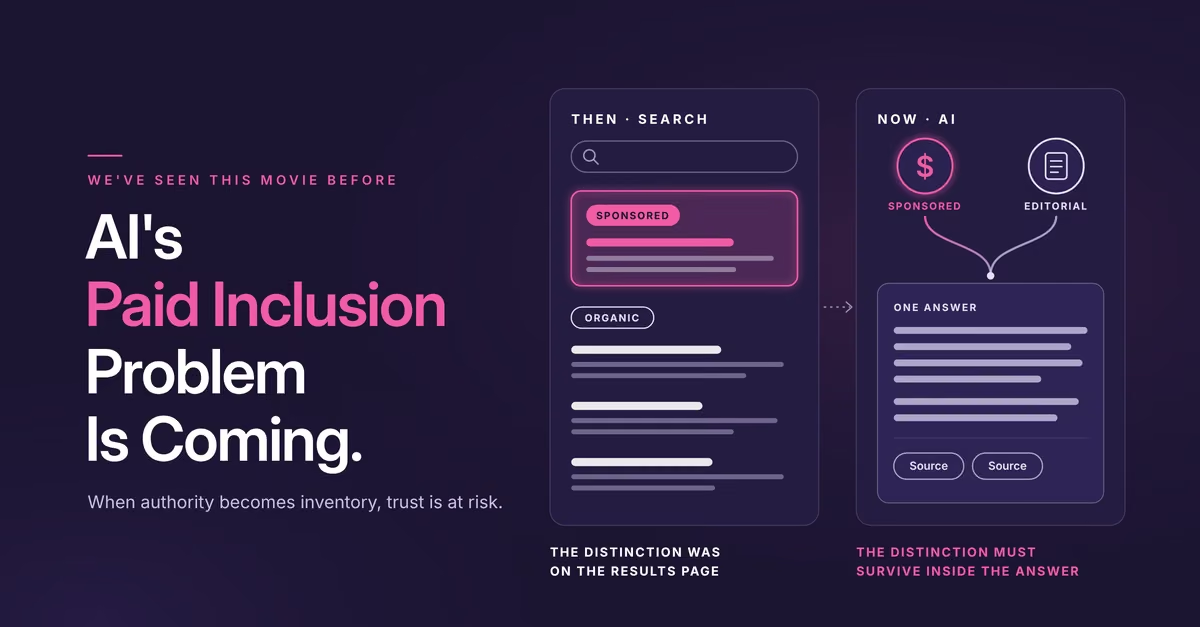
AI makes that harder to see. Some commercially engineered AI citations risk becoming the functional equivalent of paid search listings, with the transaction moved upstream and the disclosure lost along the way. Others resemble paid inclusion in their economic incentives: commercial relationships intended to influence what a discovery system encounters, without guaranteeing placement. Search gave people a list to judge. AI increasingly does the judging for them.
That matters most to platforms. An assistant’s value rests on people believing its answers are useful and independent. Commercially engineered content that enters retrieval as ordinary source material and emerges as apparently independent authority erodes that belief. AI platforms may face the calculation Ask Jeeves made in 2004, except that the commercial content now sits inside the answer itself rather than in a separate result.
As citation monetization grows, so do the platforms’ reasons to respond, whether through provenance signals, clearer distinctions between sponsored and independent sources, retrieval safeguards or policies against manipulative citation practices. Identifying sponsored content isn’t the same as penalizing it. I’m not aware of any platform doing this systematically today, but the incentive runs one way.
That creates a feedback loop. The more citations are sold, the more reason platforms have to tell commercial sources from independent ones. The better they get at it, the less value is left in any arrangement whose appeal depended on looking independently earned. The market may be building the conditions for its own deterioration.
The second pressure comes from the people being asked to pay. Standard definitions of a citation would help, but a consistent count of citations is still not a consistent measure of value.
The advertiser in that conversation said it would rather pay on Cost per Influence, provided the model was controlled, independently validated and backed by a credible source of truth. That isn’t an established standard, and renaming the unit changes nothing if the publisher defines influence, produces the evidence and decides what qualifies. The party that benefits financially from a measurement shouldn’t be the sole authority on whether it qualifies for payment. Attribution can allocate credit under agreed rules. It does not establish incremental sales, which requires different evidence, typically controlled experiments.
There’s another distinction worth making: when and why the publisher gets paid. For decades, affiliate marketing has tied publisher work to qualifying transactions, with the tracked click as the visible handoff. AI can remove the click without removing the influence, and replacing it with a paid citation solves the wrong problem. Picture a publisher that tests products and writes a buying guide no brand commissioned. If that guide later informs AI answers, compensation can be governed by independently evaluated evidence of commercial influence associated with observed transactions, under agreed attribution rules. The advertiser rewards influence the publisher has already created instead of paying to manufacture its appearance. Paying afterward doesn’t guarantee independence. Once publishers know what pays, they’ll be tempted to write toward it, and performance pay remains a material connection that may need disclosure. The safeguard isn’t the timing of payment alone. It’s preserving editorial independence while separating the evidence that determines compensation from the publisher’s financial interest in the outcome. Done that way, it’s a more defensible incentive, and it complements licensing rather than replacing it.
Put the two pressures together and you get a possible reckoning on both sides of the market before Cost per Citation is ever established: platforms getting better at separating engineered from earned authority, and advertisers declining to fund citation volume they can’t connect to outcomes. Clearly disclosed citation media and fairly licensed content can remain good businesses. Citation frequency alone looks like an unstable foundation for a performance market.
Publishers need to be paid for the value they create. Advertisers need evidence of the value they receive. AI platforms need to protect the answers people trust.
The durable opportunity is to compensate the value independent authority creates, not to pay publishers to look authoritative.
Search learned to distinguish what was bought from what was earned on a results page. AI must make that distinction inside the answer itself.