

OpenAI’s reported move toward first-party AI visibility reporting raises a larger question: who verifies commercial contribution, and who sets the rules for turning that evidence into economic decisions?
ChatGPT may soon tell brands how often it talks about them.
On November 9, Digiday reported that OpenAI is testing an analytics dashboard that counts how often a business appears in ChatGPT’s answers and how many clicks those appearances send to its site. The tool sits inside a Business Hub that has not launched. According to Digiday’s sources, it plots daily impressions and clicks but does not show prompts, user data or competitive rankings. OpenAI declined to comment.
This is a test, not a product, and only OpenAI knows what will ship. The direction still matters. One of the world’s largest AI answer engine appears to be preparing to report, in its own numbers, on commercial activity inside it. That signals a maturing market, and it opens a larger argument than the one about dashboards.
Counting is the easy part
Digiday likens the move to Google’s Search Console, which gave site owners an authoritative first-party view of organic performance. The analogy fits, with one limit. Search Console described journeys in which the click was the main event. In an AI-mediated journey, the answer often does the persuading.
Take an illustrative journey, not a documented one. A shopper asks an AI assistant for the best running shoes for flat feet. Among other inputs, the answer reflects a specialist review site. Days later she searches the brand by name and buys in its app.
Each system sees a fragment. A platform dashboard might record a mention and an impression. The affiliate system sees no referral click. Last-click attribution sees branded search. Every observation can be accurate, yet none establishes contribution: whether the answer changed her decision, whether the review shaped the answer, or whether she would have bought that brand regardless.
Clicks remain valuable. They are an increasingly incomplete record of commercial influence. That raises a question most commentary on this news will skip.
Who writes the rules?
If AI platforms become the intermediaries between consumer intent and commercial transactions, who establishes the rules for recognizing and compensating the parties that contributed to those transactions?
On the open web, contracts largely settled that. Brands and partners agreed what counted as a referral and what was paid. The click was imperfect evidence, but both sides could see it.
AI-mediated commerce increasingly weakens, and sometimes removes, that observable handoff. Much of the evidence of influence sits inside the platform. Some answers draw on identifiable publishers and creators; others don’t. And the dashboard, as reported, is built for the business that claims its listing, not for the sources whose work may have informed the answer.
That creates a quiet risk: rules get set by default rather than by design. What gets reported tends to shape what gets managed. And over time, what gets managed influences what gets funded and who receives credit. If the only AI number a brand sees is its mention count, that count will start doing the work of a contribution model, a budget allocation and a compensation policy, without anyone deciding it should.
None of this is a criticism of OpenAI. A platform knows what it showed better than anyone, and its first-party data can be authoritative for observation. But observation is not independently established contribution, a distinction that sharpens when the reporter also sells placements beside the answer. Digiday notes OpenAI was claiming a $1 billion annualized ad run rate by September. The issue is not trust. It is role.
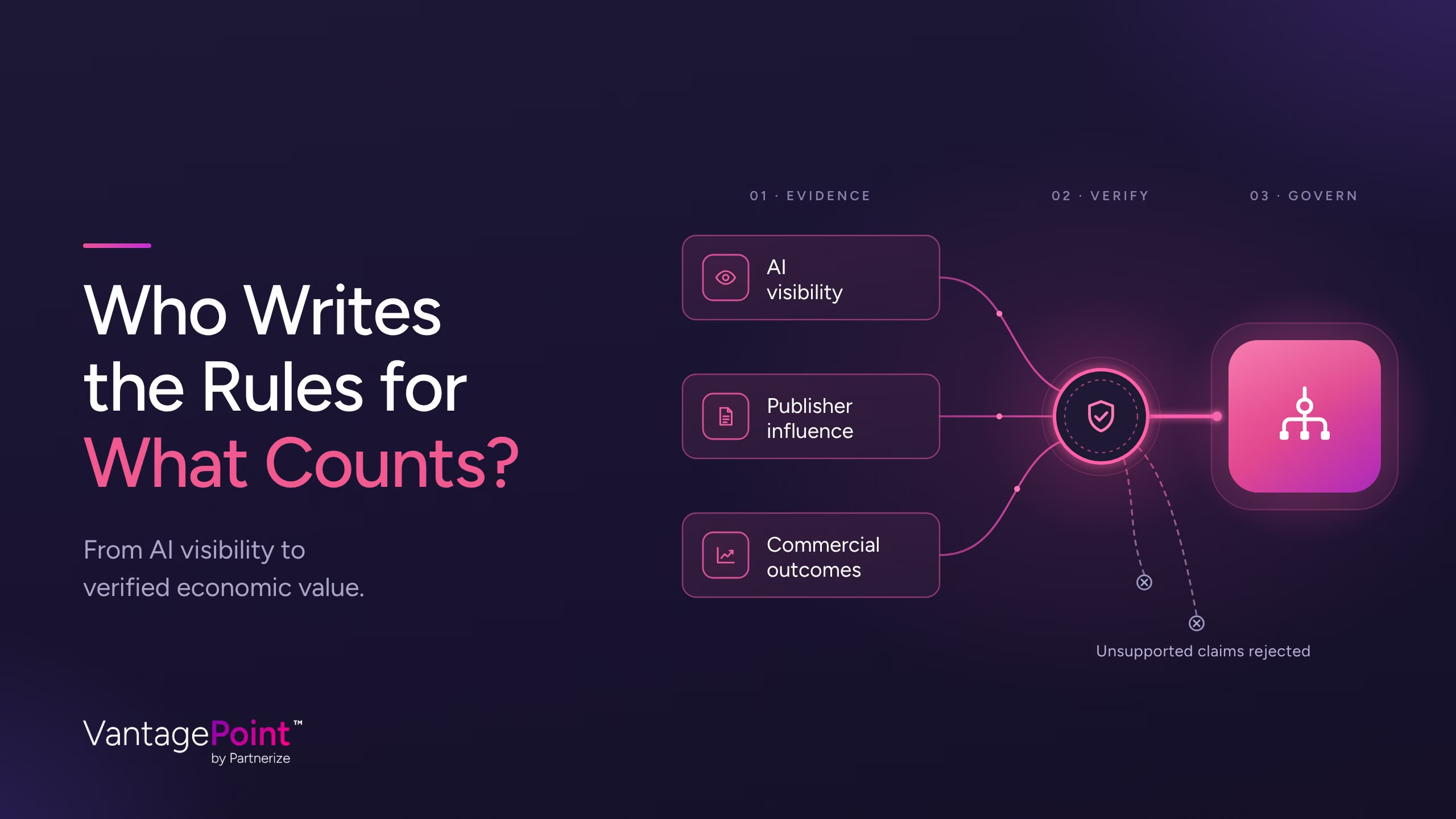
Rules made by design have a recognizable shape. They set explicit evidence thresholds and state in advance what gets a claim rejected. They sit inside transparent commercial agreements. They are auditable, with a way to resolve disputed contributions. And they connect verified evidence to compensation or investment decisions. Measurement informs those decisions. It does not make them.
Three jobs, not one
Three functions tend to get blurred.
Observation records where a brand appeared, how often and what clicks followed. Platforms are best placed to do this.
Verification weighs evidence from multiple sources (platform signals, partner content, commerce outcomes, controlled tests) and decides which contribution claims hold up. It also discards the ones that don’t. A mention does not prove influence, and a standard that never says no is not a standard.
Governance and action applies agreed rules to verified evidence: who is recognized, who is paid, where the next dollar goes.
Consider an enterprise measurement team whose AI visibility rises over a quarter in which it also increased TV spend and launched a new product line. The visibility may be driving sales, or it may be an echo: consumers asking AI assistants about a brand they just saw advertised. The count alone cannot tell the difference.
A disciplined team treats the count as a candidate signal, not an outcome. It combines available AI visibility evidence with existing media, commerce and customer data, then uses appropriate experimental and modeling techniques to test whether the signal adds explanatory or predictive value beyond established demand drivers. Where the evidence supports incremental contribution, it can inform model calibration and future investment decisions. Where it does not, the claim is set aside.
AI evidence has to enter the models, tests and budget processes enterprises already trust, not sit in yet another standalone report. Partner compensation needs the same discipline. Publishers and creators who inform AI recommendations are the least visible participants in any platform’s count, and the most exposed if recognition defaults to clicks alone.
This is the problem we built VantagePoint by Partnerize to address: assessing evidence of AI-driven influence, discarding claims that don’t hold up, and connecting what survives to the compensation and investment decisions brands already make. We’ve explored the broader economic framework in From Visibility to Value: A Field Guide to the Economic Architecture of AI-Mediated Commerce. We don’t believe every AI appearance deserves payment, or that every influence can be proven. We do believe the rules should be explicit, auditable and owned by the parties who bear the economic consequences.
The first generation of AI measurement will tell businesses where they appeared. The next will have to establish what those appearances contributed, with evidence a CFO, a partner and an auditor could each examine. The infrastructure that endures will govern what happens economically as a result.
Platforms can report visibility. The market must verify contribution. And the rules for who gets recognized, paid and funded in machine-mediated commerce are too important to inherit from whichever dashboard arrives first.